After three decades of growing psyllium and working with customers worldwide, I’ve heard nearly every possible way to psyllium husk pronounce – some correct, many creative, and a few completely unrecognizable. This seemingly simple word trips up even healthcare professionals, pharmacists, and wellness enthusiasts regularly.
The confusion is understandable given the word’s Greek origins, silent letters, and unfamiliar phonetic patterns to English speakers. Getting the psyllium husk pronunciation right matters more than you might think – it helps you communicate clearly with doctors, pharmacists, and health food store staff when seeking this beneficial fiber supplement.
In this guide, I’ll break down the correct pronunciation, explain the word’s fascinating etymology, share regional variations I’ve encountered globally, and help you master saying both “psyllium” and its alternative name “ispaghula” with complete confidence.
The Correct Way to Psyllium Husk Pronounce
Let me start with the answer everyone wants: the proper psyllium husk pronunciation.

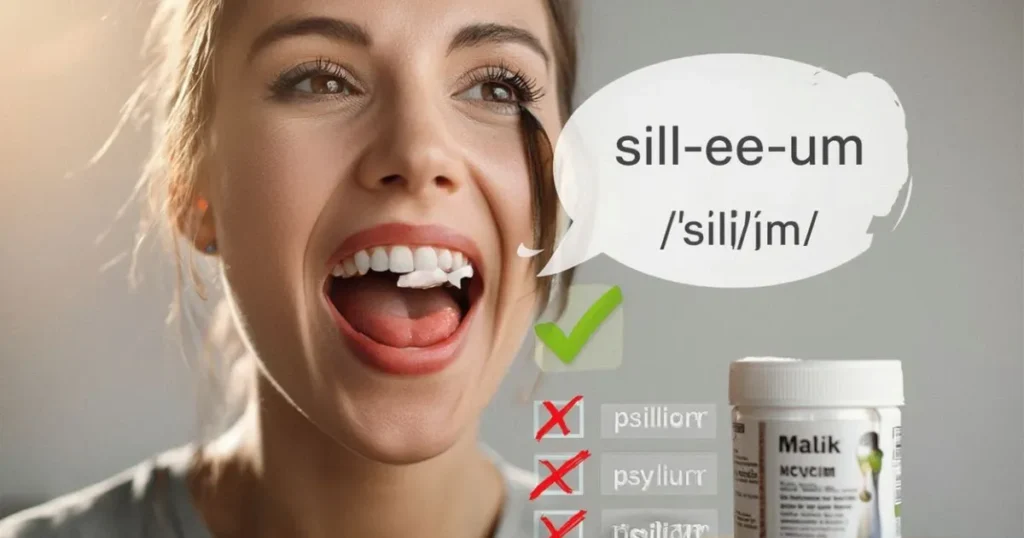
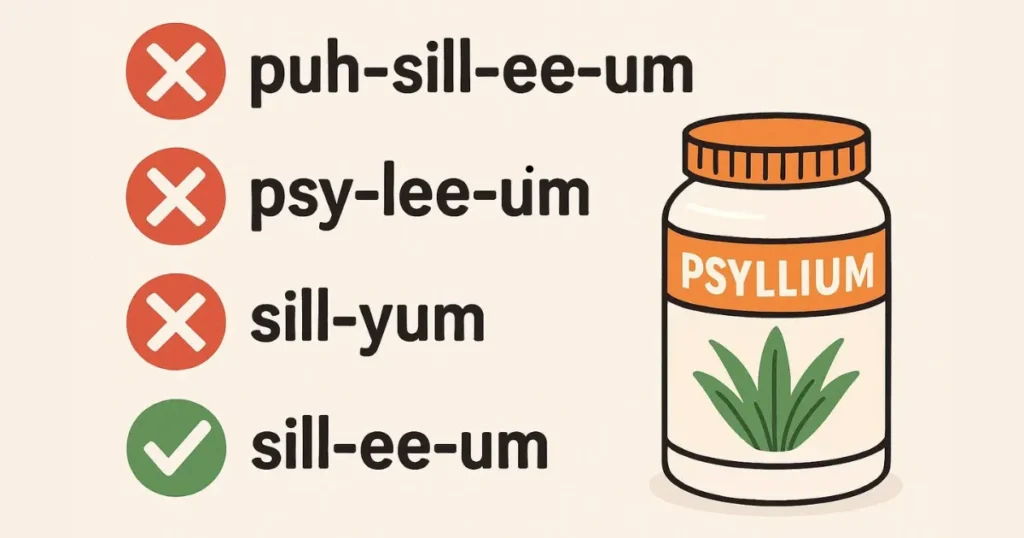
The correct pronunciation:
SILL-ee-um HUSK
That’s right – the “P” is completely silent. Say it like “silly-um” with emphasis on the first syllable.
Phonetic breakdown:
- Psyllium: / ˈsɪliəm/ (SILL-ee-um).
- Husk: / hʌsk/ (husk – this part is straightforward).
Common pronunciation mistakes:
- ❌ “Puh-SILL-ee-um” (pronouncing the P).
- ❌ “Sigh-LEE-um” (wrong emphasis).
- ❌ “SILL-yum” (missing the middle syllable).
- ❌ “Psy-LEE-um” (treating it like “psychology”).
Memory tricks:
Think “silly” + “um” = silly-um. Imagine the fiber is so simple and gentle, it’s almost silly how well it works. This mental connection helps most people remember the correct psyllium husk pronounce pattern.
Regional accent variations:
While the pronunciation stays fundamentally the same globally, I’ve noticed slight accent variations:
- American English: SILL-ee-um (clear syllables).
- British English: SILL-i-um (slightly shorter middle).
- Australian English: SILL-ee-um (similar to American).
All these variations are acceptable. The critical rule: never pronounce the P.
Understanding the Word Origin and Etymology.
Knowing where “psyllium” comes from helps explain the unusual psyllium husk pronunciation.
Greek origins:
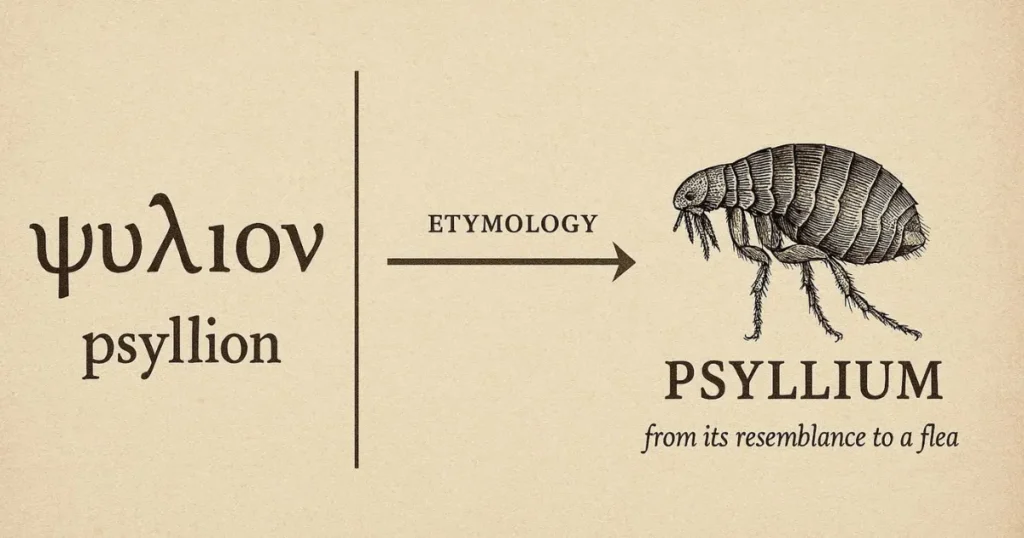
The word derives from the Greek “psyllion” (ψύλλιον), meaning “flea.” Ancient Greeks noticed the tiny psyllium seeds resembled fleas in size and dark color, hence the name.
The silent “P” explanation:
Greek-origin words in English often have silent initial letters. Think of:
- Pneumonia (P silent).
- Psychology (P silent).
- Psalm (P silent).
- Pterodactyl (P silent).
This pattern comes from Greek words beginning with “ps” where the “p” sound was pronounced in ancient Greek but became silent when adopted into English.
Latin influence:
The scientific name Plantago ovata uses Latin, but “psyllium” remained from Greek. This dual heritage creates the pronunciation complexity we navigate today.
Historical context:
I’ve researched ancient texts during my decades working with psyllium. The fiber has been used medicinally for over 2,000 years across the Mediterranean, Middle Eastern, and South Asian regions. Each culture adapted the pronunciation to their language patterns.
Ispaghula Husk Pronunciation: The Alternative Name.
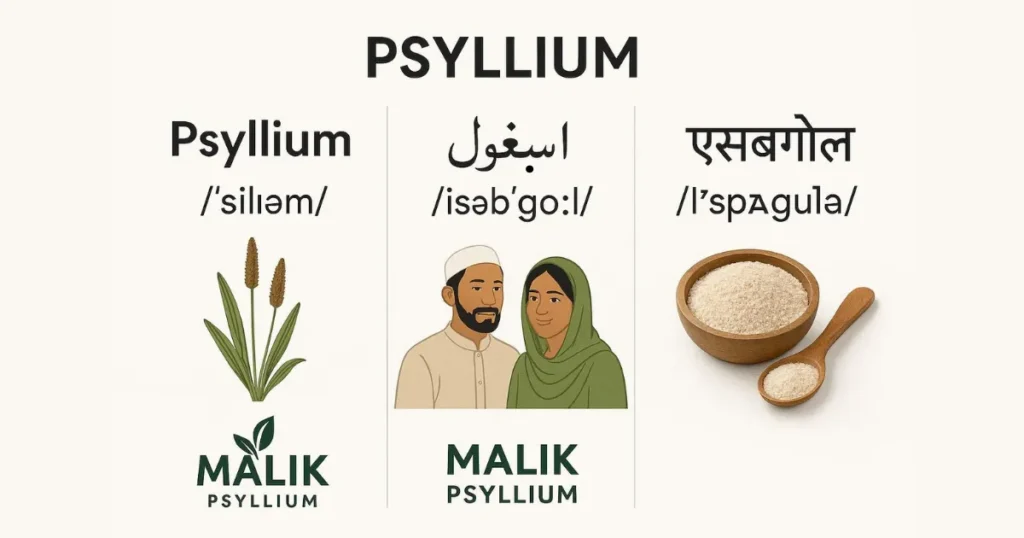
Many people wonder about the ispaghula husk pronunciation, which is psyllium’s traditional South Asian name.
The correct pronunciation:
IS-pag-OO-la or IS-pag-HU-la.
Phonetic breakdown:
- Is: Short “i” sound, like “is”.
- Pag: Like “pug” but with “a”.
- Hu/Oo: Either “hoo” or “huh” (both acceptable).
- La: Like “la” in “la-la”.
Regional variations:
- Pakistan: IS-pag-OL (slight “o” sound, emphasis on last syllable).
- India: IS-pag-HU-la (clearer “h” sound).
- Middle East: IS-ba-GOL (alternative spelling pronunciation).
Alternative spellings:
You might see:
- Isabgol.
- Ispaghol.
- Ispaghula.
- Ispagol.
All refer to the same fiber. The ispaghula husk pronunciation varies slightly with each spelling, but they’re all recognizable and acceptable.
When to use which name:
- Medical/Scientific contexts: Use “psyllium”.
- South Asian markets: Use “isabgol” or “ispaghula”.
- International wellness stores: Either works.
- Pharmacies: “Psyllium” is more universally recognized.
At Malik Psyllium, we use both names depending on the market and customer base we’re serving.
Why Pronunciation Matters in Healthcare.
Getting the psyllium husk pronounce right has practical importance beyond just sounding knowledgeable.

Clear medical communication:
When discussing fiber supplements with doctors, clear pronunciation ensures:
- No confusion with other medications.
- Accurate prescription or recommendation.
- Proper dosage communication.
- Correct product identification.
Pharmacy interactions:
Pharmacists need to understand exactly what you’re requesting. Mispronunciation might lead to:
- Wrong product suggestions.
- Confusion with other supplements.
- Delayed assistance.
- Potential medication errors.
Global travel:
I’ve worked with customers across six continents. Knowing both “psyllium” and “isabgol/ispaghula” pronunciation helps you find this beneficial fiber wherever you travel.
Online research:
Correct spelling and pronunciation help you:
- Find accurate health information.
- Locate quality products.
- Read scientific studies.
- Understand product labels.
Professional credibility:
If you’re a healthcare worker, nutritionist, or wellness coach, proper psyllium husk pronunciation establishes professional credibility with clients.
Common Mispronunciations I’ve Heard.
Through three decades in the industry, I’ve collected quite a list of creative pronunciation attempts.
The “P” pronouncers:
Most common mistake: “Puh-SILL-ee-um” or “Pie-SILL-ee-um”.
People see “ps” and want to pronounce both letters. This is understandable but incorrect.
The “psychology” approach:
Some say “Sigh-KILL-ee-um” treating it like “psychology” or “psychic.”
While the Greek root is similar, the pronunciation pattern differs.
The over-simplified:
“SILL-yum” (dropping the middle syllable entirely).
Close, but missing the complete pronunciation.
The confused:
“Psy-LAM” or “Sil-LAM” (mixing up with “Islam”).
This happens more than you’d think, especially in written-to-spoken conversion.
Regional creative attempts:
I’ve heard everything from “Sill-loom” to “Puh-zill-ee-um” to “Sill-lawn.”
Each person’s linguistic background influences how they approach unfamiliar words.
The irony:
The most educated pronunciation mistakes often come from people overthinking it. The simple “silly-um” approach works best.
Teaching Others the Correct Pronunciation.
Here’s how I help customers learn to psyllium husk pronounce correctly.
The step-by-step method:
- Write it phonetically: SILL-ee-um.
- Break it down: “silly” + “um”.
- Practice slowly: SILL/ ee/ um.
- Speed up: SILL-ee-um.
- Add “husk”: SILL-ee-um HUSK.
Visual aids that help:
Create a card:
- PSYLLIUM = SILL-ee-um.
- Cross out the P to show it’s silent.
Audio practice:
Listen to correct pronunciations online, then repeat 10 times. Muscle memory in your mouth helps more than mental memorization.
Compare to familiar words:
- “Silly” (almost identical).
- “Cilium” (the singular of cilia – same pronunciation pattern).
- “Helium” (similar ending sound).
Teaching children:
Kids often learn faster with: “It’s like saying ‘silly’ but add ‘um’ at the end!”
For non-native English speakers:
I’ve found breaking it into: “See-Lee-Um” works well for those with different native phonetic patterns.
Cultural and Regional Naming Variations.
Beyond pronunciation, psyllium has many names worldwide based on my global experience.
South Asian names:
- Urdu/Hindi: Isabgol (इसबगोल/ اسبغول).
- Persian: Ispaghol (اسپغول).
- Arabic: Bazr-e-Qatuna (بذر قطونا).
Each has its own native pronunciation that differs from English patterns.
Scientific name:
- Plantago ovata – pronounced “plan-TAY-go oh-VAH-ta”.
- Used in academic and research contexts globally.
Trade names:
Various brands use different names:
- Metamucil (MET-a-MEW-sil).
- Malik Psyllium (MAA-ly-K)
- Konsyl (KON-sil).
- Fiberall (FIE-ber-all).
These avoid the pronunciation challenge entirely but contain psyllium husk.
Professional terminology:
Healthcare professionals might say:
- “Plantago seed”.
- “Psyllium fiber”.
- “Ispaghula seed husk”.
All refer to the same therapeutic fiber I’ve cultivated for three decades.
Ispaghol / Psyllium Husk Urdu Pronunciation (اسپغول کیسے بولتے ہیں؟)
In Urdu, Ispagholis pronounced as “Is-pa-ghol” (اس-پ-غول), where the letter غ gives a soft “gh” sound from the throat. The English Ispaghula husk pronunciation is “Is-pa-gyoo-la”,while Psylliumispronounced “Sil-ee-um” (the “P” is silent). Understanding the correct Urdu and English pronunciations helps avoid confusion when buying products or reading health information.
Quality and Pronunciation: Pakistani Psyllium.
While mastering psyllium husk pronunciation, it’s worth knowing about quality sources.
Pakistani psyllium superiority:
Pakistan, particularly regions where Malik Psyllium operates, produces the world’s highest quality:
- 95-99% purity versus 85-92% elsewhere.
- Superior swelling capacity (12-14 vs. 8-10).
- Optimal climate and soil conditions.
- Generations of cultivation expertise.
Why this matters:
Regardless of how you pronounce it, quality affects results. Pakistani psyllium delivers:
- More consistent therapeutic effects.
- Better tolerance (less bloating).
- Superior gel formation.
- Pharmaceutical-grade standards.
Global recognition:
Major international markets recognize Pakistani psyllium as premium quality. Whether they say “silly-um,” “isabgol,” or regional variations, they’re seeking the same superior fiber.
Authenticity verification:
When purchasing, look for:
- Pakistan origin clearly stated.
- Purity percentage (95%+ ideal).
- Light cream to white color.
- Fine, uniform texture.
The pronunciation might vary globally, but quality standards remain universal.
Practical Tips for Daily Use.
Now that you know how the psyllium husk pronounce correctly, here’s how to use it effectively.
Ordering confidently:
Walk into any pharmacy or health store and say: “I’d like SILL-ee-um husk, please.” You’ll sound knowledgeable and get exactly what you need.
Discussing with doctors:
“I’m taking SILL-ee-um husk for digestive health” communicates clearly and professionally.
Online searching:
Spell: P-S-Y-L-L-I-U-M (remember that silent P!).
This ensures you find accurate information, quality products, and reliable research.
Explaining to family:
“It’s pronounced like ‘silly’ with ‘um’ at the end.” Simple explanations work best for sharing health information.
International travel:
Learn local names:
- Pakistan/India: Ask for “isabgol”.
- Middle East: “Ispaghol” or scientific name.
- Western countries: “Psyllium” is universally understood.
Product labels:
Read carefully – some labels use “psyllium,” others “ispaghula,” some use both. Regardless of spelling or pronunciation, verify:
- Purity percentage.
- Origin country.
- Processing standards.
- Serving size.
How Do You Psyllium Husk Pronounce Correctly?
Psyllium husk pronounce correctly as “SILL-ee-um HUSK” with the P completely silent. Say it like “silly” plus “um” – SILL-ee-um. Never pronounce the P. Emphasis is on the first syllable. This Greek-origin word follows the same silent P pattern as pneumonia, psychology, and psalm.
What Is the Ispaghula Husk Pronunciation?
The ispaghula husk pronunciation is “IS-pag-OO-la” or “IS-pag-HU-la.” This is psyllium’s traditional South Asian name. Regional variations include “isabgol” (IS-ba-GOL) in Pakistan and “ispaghol” across India and the Middle East. All refer to the same fiber supplement and are acceptable pronunciations in different markets.
What Is the Correct Psyllium Husk Pronunciation in Medical Settings?
The correct psyllium husk pronunciation in medical settings is “SILL-ee-um HUSK” (/ ˈsɪliəm hʌsk/). Healthcare professionals globally recognize this pronunciation. The P remains silent. Medical literature, prescriptions, and pharmaceutical contexts use this standard English pronunciation consistently for clear professional communication and accurate patient care.
Why is the P silent in psyllium?
The P is silent because “psyllium” derives from the Greek “psyllion” (meaning flea). Greek-origin words beginning with “ps” became anglicized with a silent P, like pneumonia, psychology, psalm, and pterodactyl. Ancient Greek pronounced both letters, but modern English dropped the P sound while keeping the spelling.
Is it pronounced “silly-um” or “sill-ee-um”?
Both describe the same sound -” SILL-ee-um” is correct. “Silly-um” is a helpful memory device since it sounds like “silly,” but the full pronunciation has three syllables: SILL (like “sill”), ee (like “see”), um (like “um”). The emphasis falls on the first syllable, making SILL-ee-um the standard pronunciation.
Do Americans and British pronounce psyllium differently?
Americans and British pronounce psyllium similarly – both say “SILL-ee-um” with a silent P. Minor accent differences exist: Americans emphasize clear three syllables (SILL-ee-um), while British speakers may slightly compress the middle (SILL-i-um). Australians follow the American pattern. All variations are correct and mutually understandable globally.
What are other names for psyllium husk?
Other names include: isabgol (South Asia), ispaghol (Pakistan/Middle East), ispaghula (scientific alternative), Plantago ovata (botanical name), plantago seed, psyllium fiber, and blond psyllium. Trade names include Metamucil, Konsyl, and Fiberall. All refer to the same fiber supplement from Plantago ovata seeds.
How do you spell psyllium correctly?
Spell psyllium: P-S-Y-L-L-I-U-M (8 letters). Remember: starts with silent P, double L in the middle, ends with I-U-M. Common misspellings include: psylium (missing L), psillium (wrong vowel), pysllium (wrong letter order). The unusual spelling reflects Greek etymology. Always check spelling when searching online or ordering products.
Conclusion.
Mastering how to psyllium husk pronounce correctly – SILL-ee-um HUSK with that crucial silent P – empowers you to communicate confidently about this beneficial fiber supplement with healthcare providers, pharmacists, and wellness professionals worldwide.
Understanding both the English psyllium husk pronunciation and the alternative ispaghula husk pronunciation (IS-pag-OO-la) ensures you can navigate global markets, research credible information, and discuss this ancient remedy with clarity, regardless of cultural or regional context.
The word’s Greek etymology explains the silent P pattern common in English medical terminology, while regional variations like isabgol reflect centuries of traditional use across South Asian and Middle Eastern cultures.
Beyond pronunciation, remember that Pakistan produces the world’s premium quality psyllium with 95-99% purity and superior therapeutic properties that deliver consistent results regardless of what you call it. Whether you say “silly-um” or “isabgol,” you’re referring to the same remarkable soluble fiber that has supported digestive wellness for over 2,000 years across countless cultures and languages worldwide.

Isabgol Ke Fayde – Psyllium Husk Ke Poori Science-Based Rahnumayi – 2026
Isabgol ke fayde jaanna aaj ke daur mein zyada zaroori
Isabgol Benefits in Hindi | Psyllium Husk Ke Fayde, Sahi Upyog Aur Savdhaniyan – 2026
Agar aap isabgol benefits in hindi mein samajhna chahte hain,