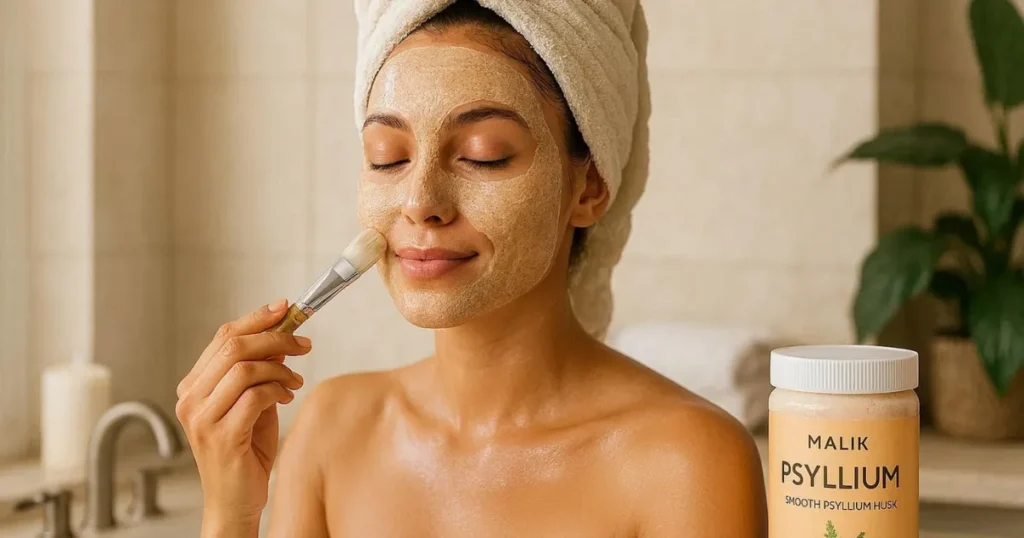
The psyllium husk face mask trend has exploded in natural skincare communities, and for good reason. This fiber-rich ingredient creates a gel-like texture that tightens, hydrates, and rejuvenates skin in ways that expensive commercial masks struggle to replicate. If you’ve been searching for an affordable, natural alternative to chemical-laden skincare products, a psyllium husk face mask might be exactly what your routine needs.
What makes a psyllium husk face mask so effective? The same mucilage that helps psyllium regulate digestion creates a protective, hydrating film on your skin. This gel locks in moisture, draws out impurities, and provides a gentle tightening effect that temporarily reduces the appearance of fine lines and pores. Unlike harsh clay masks that strip your skin, psyllium husk face masks work gently while delivering visible results.
The beauty industry has caught on to psyllium’s skincare potential, but you don’t need expensive formulations. With pure psyllium husk powder and a few simple ingredients from your kitchen, you can create professional-quality face masks at home for pennies per application. This comprehensive guide teaches you everything about psyllium husk face mask recipes, from basic formulations to advanced anti-aging blends. You’ll learn proper application techniques, skin type modifications, safety considerations, and how to maximize results. Whether you’re dealing with dryness, aging concerns, acne, or dullness, there’s a psyllium husk face mask recipe that addresses your specific needs.
What Makes Psyllium Husk Effective for Skincare
Before diving into recipes, let’s understand why a psyllium husk face mask works so well on skin.
The Mucilage Factor
Psyllium husk contains 70% soluble fiber, primarily mucilage – a gel-forming substance that absorbs water rapidly. When you mix psyllium with liquid for a face mask, this mucilage creates a viscous, slippery gel within seconds.
On your skin, this gel provides:
- Immediate hydration barrier
- Occlusive layer that prevents moisture loss
- Gentle tightening as it dries
- Smooth application without harsh texture
This natural gel is chemically similar to hyaluronic acid’s moisture-binding properties, but costs a fraction of the price.
Natural Skin Benefits
Beyond hydration, psyllium husk face masks offer multiple skincare advantages:
Pore minimizing:
As the mask dries and contracts, it temporarily tightens skin, making pores appear smaller.
Gentle exfoliation:
Removing a dried psyllium husk face mask lifts away dead skin cells without abrasive scrubbing.
Toxin absorption:
The fiber draws impurities from pores, similar to how it binds toxins in your digestive system.
Anti-inflammatory properties:
Psyllium’s soothing nature calms irritated or inflamed skin.
Improved texture:
Regular use promotes smoother, softer skin through gentle cell turnover.
Why Quality Matters for Face Masks
For skincare applications, psyllium purity is critical. Low-quality products may contain:
- Seed particles that irritate the skin
- Processing residues causing breakouts
- Inconsistent texture affecting mask performance
- Contaminants triggering allergic reactions
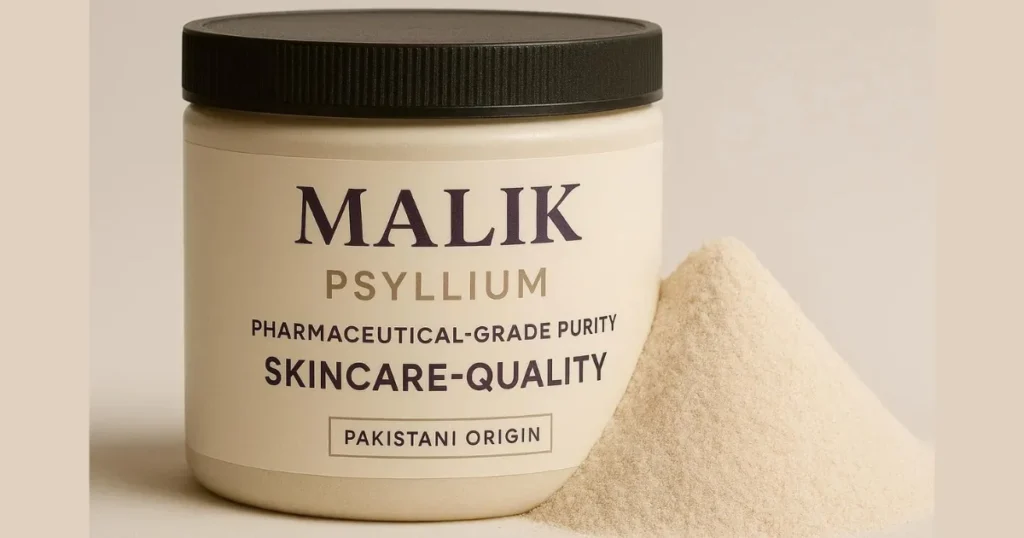
Pakistani psyllium, particularly from Sindh province, offers 95-99% purity – ideal for facial applications. At Malik Psyllium, our pharmaceutical-grade processing ensures the fine, pure texture needed for smooth, effective psyllium husk face masks.
Basic Psyllium Husk Face Mask Recipe
Let’s start with the foundational recipe you can customize based on your needs.
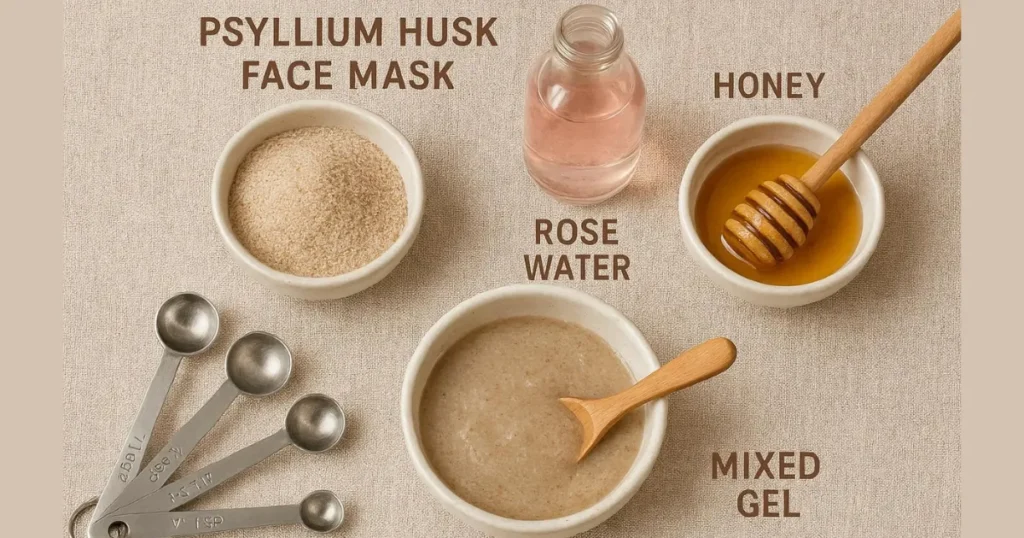
Simple Hydrating Mask (All Skin Types).
Ingredients:
- 1 teaspoon psyllium husk powder.
- 2-3 tablespoons warm water or rose water.
- Optional: 2-3 drops essential oil (lavender, tea tree).
Preparation:
- Mix psyllium powder with liquid in a small bowl.
- Stir vigorously for 30 seconds until gel forms.
- Let sit for 1-2 minutes to fully hydrate.
- Apply immediately before it thickens too much.
Application:
- Cleanse face thoroughly.
- Apply a thick, even layer, avoiding the eye area.
- Leave on for 15-20 minutes until partially dry.
- Rinse with warm water, pat dry.
- Follow with moisturizer.
This basic psyllium husk face mask provides instant hydration and gentle tightening suitable for any skin type.
Texture Adjustments.
- Too thick: Add more liquid, 1 teaspoon at a time.
- Too runny: Add a pinch more psyllium powder.
- Quick-drying climate: Use extra liquid or work in a bathroom with steam.
The gel forms rapidly, so mix right before application rather than preparing in advance.
Advanced Psyllium Husk Face Mask Recipes by Skin Type.
Customize your psyllium husk face mask with targeted ingredients for specific concerns.

Anti-Aging & Firming Mask.
Ingredients:
- 1 teaspoon psyllium husk powder.
- 2 tablespoons fresh aloe vera gel.
- 1/2 teaspoon raw honey.
- 3 drops of vitamin E oil.
- Pinch of turmeric (for brightening).
Benefits:
- Aloe provides antioxidants and promotes collagen.
- Honey offers humectant properties and gentle antibacterial action.
- Vitamin E fights free radicals.
- Turmeric reduces inflammation and brightens.
This psyllium husk face mask variation targets fine lines, loss of elasticity, and age spots.
Acne & Oil Control Mask.
Ingredients:
- 1 teaspoon psyllium husk powder.
- 2 tablespoons plain yogurt (probiotic-rich).
- 1/2 teaspoon apple cider vinegar.
- 2 drops of tea tree essential oil.
Benefits:
- Yogurt balances skin pH and provides probiotics.
- Apple cider vinegar has antibacterial properties.
- Tea tree oil fights acne-causing bacteria.
- Psyllium absorbs excess oil.
Perfect for oily or acne-prone skin seeking a clarifying psyllium husk face mask.
Brightening & Even Tone Mask.
Ingredients:
- 1 teaspoon psyllium husk powder.
- 2 tablespoons fresh lemon juice (diluted with water if sensitive).
- 1 teaspoon honey.
- Pinch of ground turmeric.
Benefits:
- Lemon provides vitamin C for brightening.
- Honey moisturizes and heals.
- Turmeric reduces hyperpigmentation.
- Psyllium creates a smooth application.
This psyllium husk face mask addresses dark spots, uneven tone, and dullness.
Sensitive & Soothing Mask.
Ingredients:
- 1 teaspoon psyllium husk powder.
- 2 tablespoons chamomile tea (cooled).
- 1 teaspoon coconut oil (melted).
- 3 drops lavender essential oil.
Benefits:
- Chamomile calms inflammation.
- Coconut oil provides gentle moisture.
- Lavender soothes irritation.
- Psyllium offers a non-irritating texture.
Ideal for reactive, sensitive, or rosacea-prone skin needing a gentle psyllium husk face mask.
Deep Hydration Mask.
Ingredients:
- 1 teaspoon psyllium husk powder.
- 2 tablespoons full-fat milk or coconut milk.
- 1/2 mashed avocado.
- 1 teaspoon honey.
Benefits:
- Milk provides lactic acid and fat for moisture.
- Avocado delivers healthy fats and vitamins.
- Honey locks in hydration.
- Psyllium creates an occlusive barrier.
This rich psyllium husk face mask rescues dry, dehydrated, or winter-stressed skin.
Application Techniques for Maximum Results.
Proper application makes the difference between okay results and transformative ones with any psyllium husk face mask.
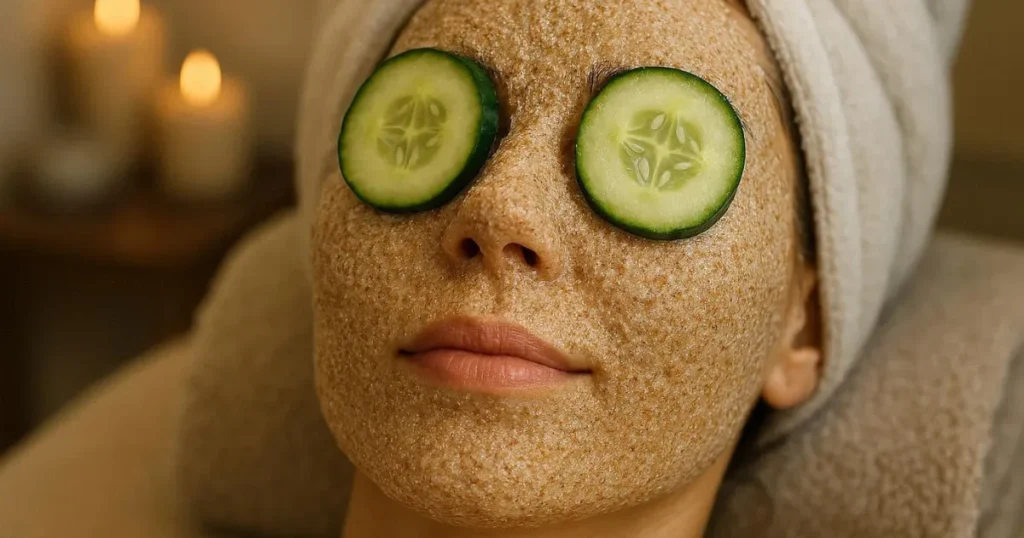
Preparation Steps.
- Cleanse thoroughly:
Remove all makeup, oil, and dirt. A clean canvas ensures maximum absorption.
- Steam (optional):
Open pores with warm steam for 5 minutes. This enhances the psyllium husk face mask’s ability to draw out impurities.
- Exfoliate gently (once weekly):
Light exfoliation before applying your psyllium husk face mask improves penetration.
Application Method.
Use clean hands or a brush: Silicone face mask brushes work perfectly for even application.
Apply a thick layer: Don’t skimp – a thick coating of your psyllium husk face mask provides better tightening and hydration.
Avoid delicate areas: Keep away from the immediate eye area and lips.
Work quickly: Psyllium gels continue thickening, so apply promptly after mixing.
Relax horizontally: Lie down while your psyllium husk face mask works to prevent sagging.
Removal Technique.
Timing matters: Remove while still slightly damp (15-20 minutes), not completely dried.
Warm water first: Soften with warm water before attempting removal.
Gentle circular motions: Use fingertips to massage gently while rinsing – this exfoliates dead cells.
Pat dry: Don’t rub aggressively.
Follow immediately with products: Apply serums and moisturizer while skin is damp for better absorption.
Frequency and Skincare Routine Integration.
How often should you use a psyllium husk face mask, and how does it fit into your overall routine?
Recommended Frequency.
- Normal to dry skin: 2-3 times per week.
- Oily or acne-prone: 3-4 times per week.
- Sensitive skin: 1-2 times per week.
- Mature skin (anti-aging): 2-3 times per week.
Consistency matters more than frequency. Regular use of a psyllium husk face mask produces cumulative benefits.
Best Timing.
Evening routine preferred:
Your skin repairs itself overnight, making evening application of a psyllium husk face mask ideal for maximizing benefits.
Before special events:
Apply 24 hours before for a temporary tightening effect.
Post-workout:
After exercise, open pores readily absorb your psyllium husk face mask ingredients.
Weekend self-care:
Dedicate 30 minutes to a complete facial experience.
Routine Integration.
Morning routine:
- Cleanser.
- Toner.
- Serum.
- Moisturizer.
- SPF.
Evening routine (with mask):
- Cleanse.
- Steam (optional).
- Psyllium husk face mask (2-3x weekly).
- Toner.
- Serum.
- Night cream.
This integration maximizes the effectiveness of your psyllium face mask without overwhelming skin.
Benefits beyond Basic Hydration.
A psyllium husk face mask offers advantages that extend beyond simple moisture.
Temporary Wrinkle Reduction.
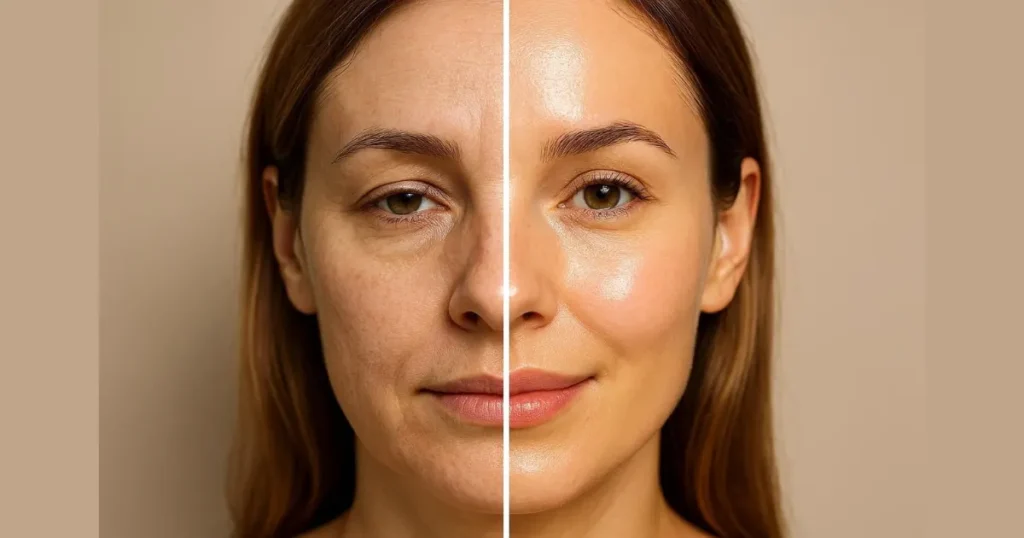
The tightening effect of a psyllium husk face mask creates an immediate, though temporary, reduction in fine line appearance. While not permanent like Botox, it’s perfect for before photos or events.
How it works: As the gel dries, it contracts slightly, pulling skin taut and smoothing surface wrinkles.
Duration: Effects last 8-12 hours typically.
Best for: Expression lines, crow’s feet, and forehead lines.
Pore Appearance Improvement.
Regular psyllium face mask use makes pores appear smaller through several mechanisms:.
Physical tightening: The drying effect temporarily constricts pore openings.
Deep cleaning: Psyllium draws out sebum and debris clogging pores.
Exfoliation during removal: Lifting away dead cells prevents pore blockage.
Improved Product Absorption.
Using a psyllium husk face mask before your regular skincare enhances subsequent product effectiveness. The gentle exfoliation and moisture barrier preparation allow serums and treatments to penetrate more deeply.
Natural Glow Enhancement.
The combination of hydration, exfoliation, and improved circulation from application creates what beauty experts call “the glow” – that lit-from-within radiance. Regular psyllium face mask users report noticeably brighter, more luminous complexions.
Calming Inflammation.
Whether you’re dealing with acne, rosacea, or general sensitivity, a psyllium face mask’s anti-inflammatory properties help reduce redness and irritation without harsh chemicals.
Safety Considerations and Patch Testing.
While generally safe, any new skincare product – including a psyllium husk face mask – requires proper safety precautions.
Patch Test Protocol.
Before your first full-face application:
- Day 1: Mix a small amount of your chosen psyllium husk face mask recipe. Apply a quarter-sized amount to the inner forearm. Wait 24 hours.
- Day 2: Check for reactions (redness, itching, swelling, burning).
- If clear: Proceed with face application.
- If a reaction occurs: Discontinue or modify ingredients.
This simple test prevents potentially uncomfortable facial reactions.
Contraindications.
Avoid using a psyllium husk face mask if you have:
- Known psyllium allergy (rare but possible).
- Active cold sores or open wounds.
- Severe acne cysts (consult dermatologist first).
- Extremely sensitive skin that reacts to most products.
Common Side Effects.
Normal reactions:
- Slight tingling (from active ingredients like lemon or ACV).
- Temporary redness (fades within 30 minutes).
- Tightness sensation while wearing a mask.
Concerning reactions:
- Intense burning or stinging.
- Persistent redness beyond 1 hour.
- Swelling or hives.
- Breakouts after multiple uses.
If concerning reactions occur, discontinue your psyllium husk face mask immediately and consult a dermatologist.
Ingredient Cautions.
- Lemon juice: Can increase sun sensitivity – always use SPF after.
- Essential oils: Use sparingly (2-3 drops max) and choose skin-safe varieties.
- Apple cider vinegar: Dilute properly to avoid chemical burns.
- Turmeric: May temporarily stain light skin (fades within hours).
Psyllium Husk Face Mask vs. Commercial Alternatives.
How does a DIY psyllium husk face mask compare to store-bought options?
Cost Comparison.
- Commercial hydrating masks: $15-50 per container (15-20 uses).
- Commercial anti-aging masks: $30-100+ per container.
- Sheet masks: $2-8 per single use.
DIY psyllium husk face mask:
- Pure psyllium: $10-15 for 12 oz (100+ masks).
- Additional ingredients: $10-20 total.
- Cost per use: $0.25-0.50.
The savings are substantial while quality remains high.
Ingredient Transparency.
Commercial masks often contain:
- Preservatives (parabens, phenoxyethanol).
- Synthetic fragrances.
- Fillers and thickeners.
- Potential irritants.
Psyllium husk face mask benefits:
- Complete ingredient control.
- No hidden chemicals.
- Customizable for your needs.
- Fresh preparation ensures potency.
Effectiveness Comparison.
| Feature | Commercial Masks | Psyllium Husk Face Mask |
| Hydration | Good | Excellent |
| Tightening | Varies | Moderate to good |
| Customization | None | Complete control |
| Freshness | Preservatives needed | Made fresh each use |
| Cost per use | $1-8 | $0.25-0.50 |
| Natural ingredients | Varies widely | 100% control |
A properly formulated psyllium husk face mask rivals or exceeds commercial options at a fraction of the cost.
Storage and Preparation Tips.
Maximizing your psyllium husk face mask experience requires proper handling.
Storing Psyllium Powder.
Optimal conditions:
- Airtight container.
- Cool, dry location.
- Away from direct sunlight.
- Separate from moisture sources.
Shelf life:
Pure psyllium lasts 2+ years when stored properly.
Quality check:
Discard if you notice a musty smell, clumping, or discoloration.
Preparing Ingredients.
Fresh is best:
Make your psyllium husk face mask immediately before use. Pre-mixed batches separate and lose effectiveness.
Room temperature liquids:
Cold liquids slow gel formation; warm liquids speed it up.
Clean equipment:
Use sanitized bowls and utensils to prevent bacterial introduction.
Modification for Climate.
Humid environments:
Reduce the liquid slightly in your psyllium husk face mask recipe – the mask will stay workable longer.
Dry climates:
Increase liquid and work quickly as the psyllium husk face mask dries faster.
Cold weather:
Warm your mixing liquid slightly for better gel formation.
Combining with Other Natural Ingredients.
Enhance your psyllium husk face mask with complementary natural ingredients.
Powerful Additions.
Activated charcoal (1/2 teaspoon):
Add to your psyllium husk face mask for deep pore cleansing and toxin removal.
Matcha powder (1/2 teaspoon):
Provides antioxidants and gentle detoxification in your psyllium face mask.
Spirulina (1/4 teaspoon):
Adds vitamins and minerals to your psyllium husk face mask for nourishment.
Oatmeal (1 teaspoon, finely ground):
Enhances the soothing properties of your psyllium face mask for sensitive skin.
Bentonite clay (1/2 teaspoon):
Combines with your psyllium husk face mask for enhanced oil absorption.
Hydrosol and Tea Bases.
Replace plain water in your psyllium husk face mask with:
- Rose water (hydrating, anti-inflammatory).
- Green tea (antioxidant-rich).
- Chamomile tea (calming).
- Witch hazel (astringent for oily skin).
These additions customize your psyllium face mask for specific concerns.
Common Mistakes to Avoid.
Learn from common errors people make with psyllium face mask applications.
Mistake 1: Using Too Much Psyllium.
Problem: Creates overly thick, unworkable paste that’s difficult to apply.
Solution: Start with 1 teaspoon psyllium per psyllium husk face mask. Add more liquid rather than more powder.
Mistake 2: Letting It Dry Completely.
Problem: Fully dried psyllium husk face masks become difficult to remove and can pull delicate skin.
Solution: Remove while still slightly damp (15-20 minutes), before complete drying.
Mistake 3: Skipping Patch Tests.
Problem: Discovering ingredient sensitivities on your entire face.
Solution: Always patch test new psyllium face mask recipes before full application.
Mistake 4: Inconsistent Use.
Problem: Expecting dramatic results from occasional use.
Solution: Use your psyllium husk face mask 2-3 times weekly for cumulative benefits.
Mistake 5: Poor Quality Psyllium.
Problem: Impure psyllium creates a gritty texture and potential irritation.
Solution: Choose pharmaceutical-grade psyllium from reputable sources like Malik Psyllium for smooth, effective psyllium husk face masks.
Maximizing Long-Term Results.
Transform occasional psyllium face mask use into lasting skin improvement.
Building a Routine.
Week 1-2:
Use basic hydrating psyllium husk face mask 2x weekly to assess tolerance.
Week 3-4:
Introduce targeted psyllium face mask recipes for specific concerns.
Week 5+:
Settle into consistent 2-3x weekly routine with your preferred psyllium husk face mask variations.
Tracking Progress.
Document your psyllium husk face mask journey:
- Take photos weekly (same lighting, no makeup).
- Note skin texture, hydration, and tone changes.
- Adjust recipes based on seasonal needs.
- Experiment with ingredient combinations.
Combining with Lifestyle Factors.
Your psyllium husk face mask works best alongside:
- Adequate hydration (8-10 glasses of water daily).
- Balanced diet rich in antioxidants.
- Quality sleep (7-9 hours).
- Sun protection (daily SPF).
- Stress management.
External skincare supports internal health, and vice versa.
Professional Perspective on DIY Skincare.
As someone who works with psyllium quality daily, I can offer unique insights into psyllium husk face mask effectiveness.
Quality Makes the Difference.
Not all psyllium is suitable for facial use. The fine, pure powder needed for smooth psyllium face masks requires:
- Multiple cleaning stages removing seed particles.
- Consistent particle size for even texture.
- Pharmaceutical-grade processing standards.
- Freedom from contaminants or residues.
Pakistani psyllium’s 95-99% purity makes it ideal for skincare applications. Lower-grade products may irritate sensitive facial skin or create an unpleasant texture in your psyllium husk face mask.
Realistic Expectations.
A psyllium husk face mask provides genuine benefits but isn’t magic:
What it does well:
- Immediate hydration boost.
- Temporary tightening and smoothing.
- Gentle exfoliation.
- Affordable luxury skincare experience.
What it cannot do:
- Permanently eliminate wrinkles.
- Replace medical treatments for acne or rosacea.
- Provide instant permanent results.
- Substitute for a comprehensive skincare routine.
View your psyllium husk face mask as one valuable component of holistic skin health, not a standalone miracle cure.
How do I make a basic psyllium husk face mask?
Mix 1 teaspoon psyllium husk powder with 2-3 tablespoons warm water or rose water. Stir until gel forms, apply to clean face, leave 15-20 minutes, rinse. Customize with honey, aloe, or oils.
Is a psyllium husk face mask safe for all skin types?
Yes, psyllium husk face masks suit all skin types when properly formulated. Sensitive skin should patch test first. Adjust additional ingredients based on whether you have oily, dry, or combination skin.
How often should I use a psyllium husk face mask?
Use your psyllium husk face mask 2-3 times weekly for normal skin, 3-4 times for oily skin, and 1-2 times for sensitive skin. Consistency matters more than frequency for results.
Can psyllium husk face masks reduce wrinkles?
Psyllium husk face masks provide temporary tightening that reduces fine line appearance for 8-12 hours. Regular use improves skin texture and hydration, but doesn’t permanently eliminate wrinkles like medical treatments.
What ingredients work best in psyllium husk face masks?
Honey, aloe vera, yogurt, avocado, and essential oils (tea tree, lavender) work excellently in psyllium husk face mask recipes. Choose additions based on your skin concerns – hydration, anti-aging, or acne control.
Should I let my psyllium husk face mask dry completely?
No, remove your psyllium husk face mask while still slightly damp (after 15-20 minutes). Completely dried masks become difficult to remove and may pull delicate facial skin uncomfortably.
Can I store pre-made psyllium husk face masks?
No, make your psyllium husk face mask fresh each time. The gel separates and loses effectiveness when stored. Mix immediately before application for best results and hygiene.
Does psyllium quality matter for face masks?
Yes, high-purity psyllium (95-99%) from sources like Pakistani Malik Psyllium creates smooth, irritation-free psyllium husk face masks. Low-quality products may contain seed particles that irritate facial skin.
Conclusion.
A psyllium husk face mask offers an accessible, effective entry point into natural skincare that rivals expensive commercial alternatives. The same mucilage that makes psyllium valuable for digestive health creates remarkable benefits when applied topically – immediate hydration, gentle tightening, pore refinement, and a natural glow that beauty enthusiasts worldwide are discovering.
The versatility of psyllium face mask recipes means you can customize formulations for your exact skin type and concerns. Whether you’re fighting aging signs with antioxidant-rich ingredients, managing acne with antibacterial additions, or simply seeking affordable hydration, psyllium provides the perfect base for infinite variations.
Quality matters significantly when using psyllium for facial applications. The pharmaceutical-grade purity of Pakistani psyllium from sources like Malik Psyllium ensures smooth texture, freedom from irritating particles, and consistent results that lower-grade products simply cannot deliver. For skincare use, premium quality isn’t optional – it’s essential for both effectiveness and safety.
Start with the basic hydrating psyllium husk face mask to establish tolerance, then experiment with targeted recipes addressing your specific concerns. Commit to 2-3 weekly applications for at least a month before judging results. Document your progress through photos and notes. Most importantly, remember that any psyllium face mask works best as part of comprehensive skin health – proper hydration, sun protection, quality sleep, and stress management all contribute to the glowing complexion you’re seeking.

Isabgol Ke Fayde – Psyllium Husk Ke Poori Science-Based Rahnumayi – 2026
Isabgol ke fayde jaanna aaj ke daur mein zyada zaroori
Isabgol Benefits in Hindi | Psyllium Husk Ke Fayde, Sahi Upyog Aur Savdhaniyan – 2026
Agar aap isabgol benefits in hindi mein samajhna chahte hain,