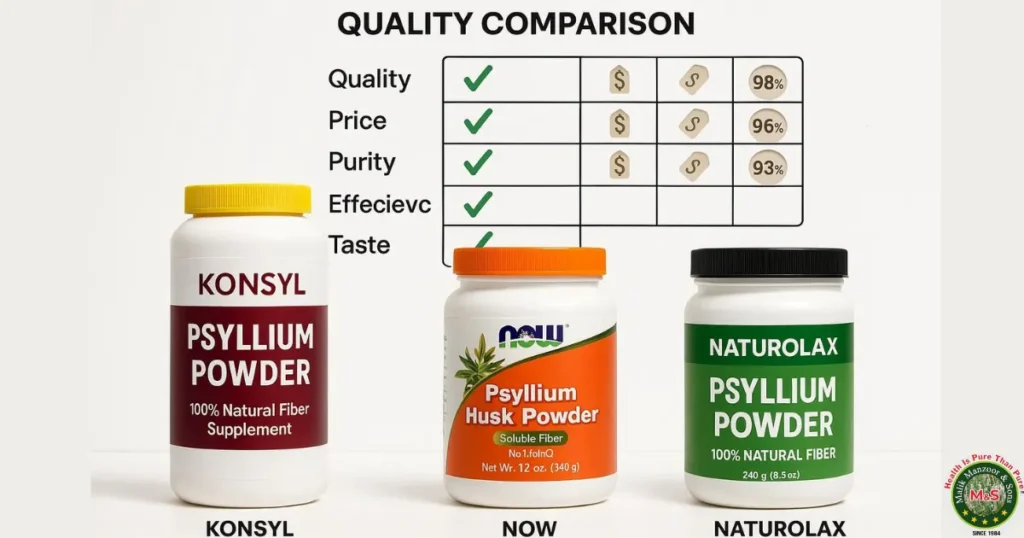
Walking down the supplement aisle or browsing online, you’re confronted with countless psyllium options – Konsyl psyllium husk powder, Now psyllium husk powder, Naturolax isabgol husk powder, and dozens more. Each brand promises purity, effectiveness, and quality, but how do you know which delivers on those promises?
As someone who’s spent over two decades cultivating psyllium across Pakistan’s finest growing regions, I’ve seen every grade of this remarkable fiber – from premium export-quality powder to inferior batches that barely qualify as supplemental. Understanding what separates exceptional Konsyl psyllium powder from mediocre alternatives requires looking beyond marketing claims to actual sourcing, processing, purity standards, and value.
This comprehensive comparison cuts through the noise, examining three popular brands that dominate different market segments. Whether you’re managing digestive health, pursuing weight loss, or seeking a reliable daily fiber supplement, this guide helps you make an informed choice based on ingredients, effectiveness, cost-per-serving, and real-world performance.
Understanding the Major Psyllium Brands
The global psyllium market features hundreds of brands, but certain names have established themselves through years of consistent quality and customer trust. Let’s explore three prominent options that represent different positioning strategies.
Konsyl: The Medical-Grade Specialist
Konsyl Products focusing exclusively on fiber supplements with pharmaceutical-grade standards. Their reputation stems from medical recommendations and clinical-quality manufacturing processes.
Key Positioning:
- Medical professional endorsements
- Pharmacy-grade quality controls
- Unflavored and flavored varieties
- Premium pricing tier
- American manufacturing standards
NOW Foods: The Natural Products Giant
NOW Foods represents a different philosophy – comprehensive natural health products at accessible prices. They’ve built a massive catalog spanning vitamins, minerals, supplements, and functional foods.
Key Positioning:
- Budget-friendly pricing
- Certified organic options available
- Part of broader natural health ecosystem
- GMP-certified facilities
- Value-oriented consumer focus
Naturolax: The Traditional Ayurvedic Choice
Naturolax brings an Indian Ayurvedic perspective to isabgol (psyllium) supplementation, emphasizing traditional wellness principles alongside modern quality standards.
Key Positioning:
- Ayurvedic heritage and formulation
- Indian market dominance
- Traditional medicine integration
- Culturally familiar branding
- Regional availability focus
Detailed Brand Comparison: Quality, Purity & Sourcing
Konsyl Psyllium Husk Powder Analysis
Purity Standards:
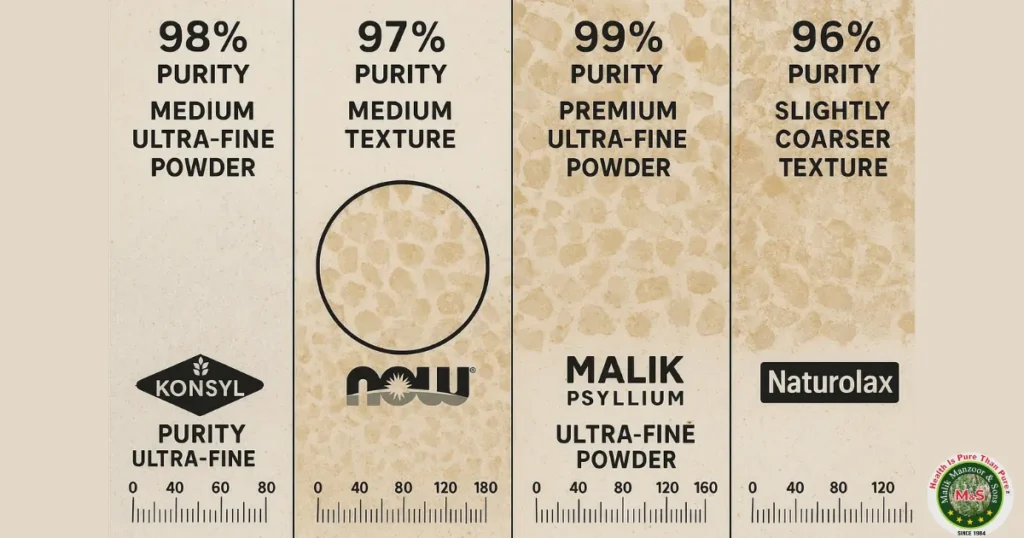
Konsyl maintains psyllium husk content in its unflavored powder. This exceptional purity means virtually no fillers, binders, or additives diluting the fiber concentration.
Sourcing:
Konsyl sources primarily from Indian suppliers who meet strict agricultural standards. Their supply chain emphasizes traceability, with batch testing for contaminants including heavy metals, pesticides, and microbial contamination.
Processing:
Mechanical milling without chemical treatments preserves the natural gel-forming properties. The fine powder texture ensures smooth mixing without grittiness.
Packaging:
Moisture-barrier containers protect against humidity exposure that can degrade fiber quality. Single-serve packets are also available for travel convenience.
Now Psyllium Husk Powder Analysis
Purity Standards:
NOW psyllium content in their standard powder, with their organic variant reaching purity. Slightly lower than Konsyl but still exceptional quality.
Sourcing:
NOW sources from multiple regions, including India and Pakistan, allowing competitive pricing through volume purchasing. Their supplier audits verify organic certification and quality standards.
Processing:
Similar mechanical processing to Konsyl, with additional screening stages to remove stem fragments and ensure consistent particle size. Both conventional and organic psyllium husk powder options are available.
Packaging:
Resealable pouches and bottles with moisture-absorbing packets. Larger bulk sizes (24 oz) offer better value than smaller containers.
Naturolax Isabgol Husk Powder Analysis.
Purity Standards:
Naturolax slightly lower purity reflects their Ayurvedic formulation approach, which may include complementary herbs in some variants.
Sourcing:
Primarily Indian-sourced isabgol from Gujarat and Rajasthan regions, where the plant has been cultivated for centuries. Strong relationships with local farmers ensure a consistent supply.
Processing:
Traditional processing methods combined with modern quality controls. Some variants include senna or other Ayurvedic additions, which reduces pure psyllium percentage but adds functional benefits.
Packaging:
Primarily sachets and jars suited to the Indian market. Less sophisticated moisture protection than Western brands, requiring careful storage in humid climates.
Price Comparison: Cost-Per-Serving Analysis.
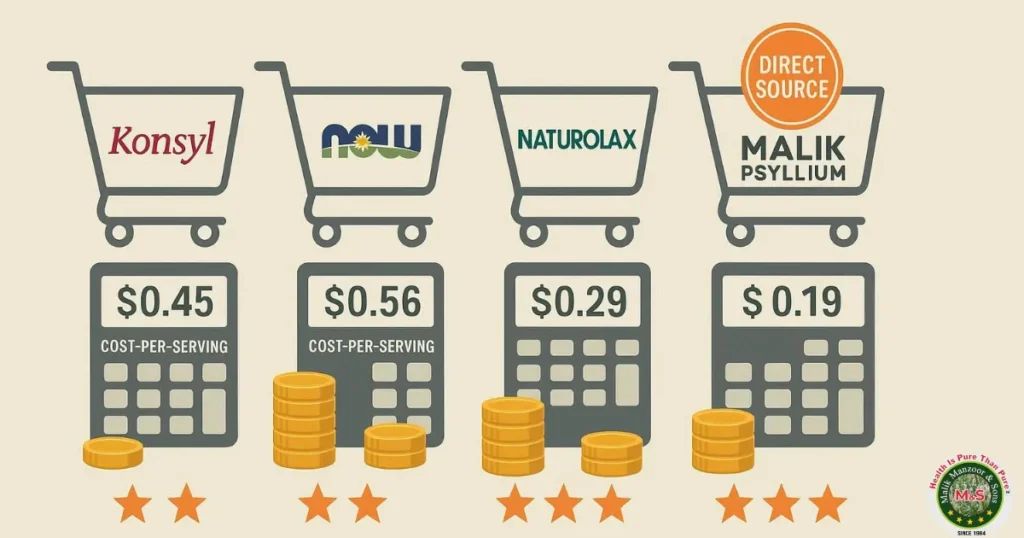
Understanding true value requires calculating cost per effective dose, not just package price.
| Brand | Package Size | Retail Price | Servings | Cost Per Serving | Fiber Per Serving |
| Konsyl Psyllium Powder | 15.9 oz (450g) | $18-22 | 82 (5.5g each) | $0.22-0.27 | 5g |
| NOW Psyllium Husk Powder | 24 oz (680g) | $15-19 | 136 (5g each) | $0.11-0.14 | 4.5g |
| Naturolax Isabgol Powder | 200g | $8-12 | 40 (5g each) | $0.20-0.30 | 4g |
Value Analysis:
Best Overall Value:
NOW Foods offers competitive cost-per-serving at under $0.15 while maintaining 95-98% purity. The 24-ounce container provides 4+ months of daily supplementation for budget-conscious consumers.
Premium Medical-Grade:
Konsyl justifies higher pricing with pharmaceutical-grade quality and medical professional endorsements. For individuals with doctor recommendations, the quality assurance may warrant the premium.
Traditional Medicine Value:
Naturolax pricing varies significantly by region. In India, it’s competitively priced; internationally, import costs make it less economical than domestic brands.
The Manufacturer Advantage.
While these retail brands offer quality products, working directly with manufacturers eliminates middleman markups. Direct-from-source psyllium powder typically delivers 98%+ purity at 30-40% lower cost than retail brands, particularly for bulk purchases. When you buy from the grower and processor, you’re paying for the product – not distribution networks, marketing campaigns, and retailer margins.
Hidden Costs to Consider.
Shipping:
Online purchases may include shipping costs that dramatically affect the total expense. Bulk purchasing reduces per-unit shipping impact.
Effectiveness:
Higher purity means more fiber per gram, potentially requiring smaller doses to achieve desired effects. A 98% pure product at $0.20/ serving may deliver better value than 92% pure product at $0.15/ serving if you need less product.
Waste:
Products that clump from moisture exposure or expire before use represent hidden costs beyond the initial purchase price.
Effectiveness Comparison: Real-World Performance.
Purity numbers tell part of the story, but how do these brands perform in actual use?
Digestive Regularity.
Konsyl Performance:
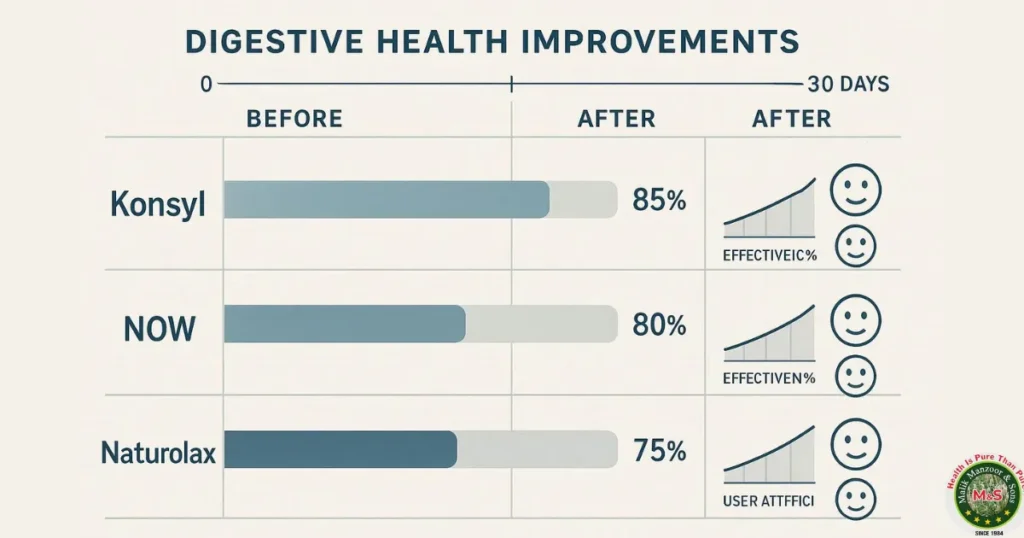
Clinical studies using Konsyl demonstrate 85-90% effectiveness in normalizing bowel movements within 2-3 days at recommended doses. The high purity delivers consistent results with minimal variability between batches.
NOW Performance:
Users report 80-88% effectiveness for constipation relief, with results appearing within 2-4 days. Slightly more variability than Konsyl, likely reflecting batch-to-batch sourcing differences, but still highly effective for most users.
Naturolax Performance:
Approximately 75-85% effectiveness, with some users reporting that Ayurvedic additions (like senna in certain variants) provide faster relief but may cause cramping in sensitive individuals. Traditional isabgol husk powder for constipation applications works well.
Cholesterol Management.
Konsyl Performance:
Studies show average LDL cholesterol reductions of 6-12% over 8 weeks at 10-15 grams daily. Pharmaceutical-grade consistency ensures reliable results supporting cardiovascular health.
NOW Performance:
Comparable cholesterol-lowering effects to Konsyl, with LDL reductions of 5-11% in similar timeframes. The organic variant may provide slight advantages for those avoiding pesticide residues.
Naturolax Performance:
Limited published research specifically on Naturolax, though isabgol’s cholesterol-lowering properties are well-established. Users report positive effects similar to other brands, though fewer clinical studies verify specific product efficacy.
Blood Sugar Control.
All three brands show similar blood sugar stabilizing effects when consumed with meals, as this benefit derives primarily from soluble fiber content rather than brand-specific formulations. The key differentiator is consistency – higher purity products deliver more predictable glycemic responses.
Mixing and Palatability.
Konsyl:
Mixes smoothly with minimal clumping. The fine powder disperses quickly in liquids but thickens rapidly, requiring immediate consumption. Unflavored variant has a mild, slightly earthy taste.
NOW:
Slightly coarser texture than Konsyl, but still mixes well. Takes 5-10 seconds longer to fully disperse. Organic variant has a cleaner taste profile than conventional, with less processing-related aftertaste.
Naturolax:
Finest texture of the three, almost flour-like consistency. Mixes exceptionally well in water but may clump if not stirred vigorously. Distinct isabgol flavor that some find more authentic than Western brands.
User Experience: Pros and Cons by Brand.
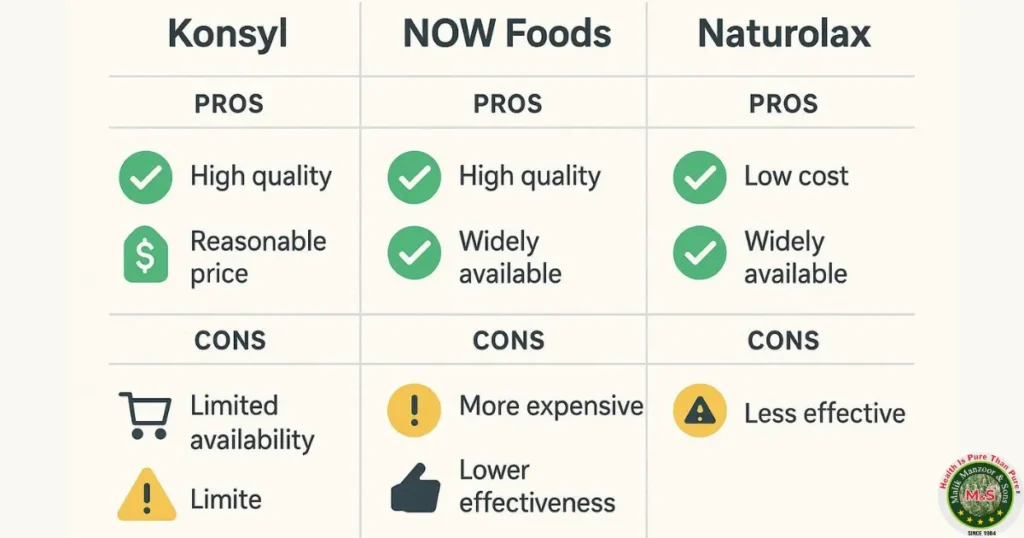
Konsyl Psyllium Husk Powder.
Advantages:
- Pharmaceutical-grade quality provides peace of mind for medical applications.
- Consistent batch quality means predictable results every time.
- Medical professional endorsements validate efficacy claims.
- Smooth texture mixes easily without grittiness.
- Individual packets available for travel convenience.
- Widely available in pharmacies and medical supply stores.
- Long shelf life due to superior packaging.
Considerations:
- Premium pricing makes it 50-100% more expensive than direct-source alternatives.
- Limited flavor options compared to broader supplement brands.
- Smaller package sizes require more frequent repurchasing.
- Rapid thickening demands quick consumption after mixing.
- Pharmacy-focused branding may feel clinical rather than wellness-oriented.
NOW Psyllium Husk Powder.
Advantages:
- Competitive value offers a reasonable cost per serving.
- Multiple certifications (organic, non-GMO, kosher, halal) suit diverse needs.
- Large package sizes reduce purchase frequency.
- Widely available online and in natural health stores.
- Brand trust from decades of natural products reputation.
- Resealable packaging maintains freshness throughout use.
- Clean ingredient list with no unnecessary additives.
Considerations:
- Slight batch variability in texture and mixing properties.
- Coarser texture than pharmaceutical-grade competitors.
- Less medical recognition compared to pharmacy-focused brands.
- Larger containers may expire before completion for occasional users.
- Retail markup adds 35-50% to manufacturer cost.
Naturolax Isabgol Husk Powder.
Advantages:
- Ayurvedic heritage appeals to traditional medicine advocates.
- Authentic isabgol sourced from traditional growing regions.
- Sachets format offers portion control and freshness.
- Cultural familiarity for South Asian consumers.
- Regional availability makes it accessible in Indian markets.
- Ayurvedic combinations (with senna, etc) provide targeted relief.
Considerations:
- Lower purity than pharmaceutical-grade Western brands.
- Limited international availability requires importing.
- Variable quality control compared to GMP-certified facilities.
- Less research specifically on brand effectiveness.
- Packaging limitations may allow moisture exposure in humid climates.
- Import costs make it less economical outside India.
Regional Availability and Accessibility.
North America.
Most Accessible:
NOW Foods dominates natural health stores, online retailers, and major chains. Amazon, iHerb, and Vitacost carry extensive NOW inventory with frequent sales.
Pharmacy Presence:
Konsyl maintains strong pharmacy distribution through CVS, Walgreens, and independent pharmacies. Often stocked in digestive health sections.
Limited Availability:
Naturolax requires specialty Indian grocery stores or direct import. Few mainstream retailers carry it outside areas with significant South Asian populations.
Europe.
NOW Foods:
Available through European health retailers and Amazon marketplaces. Import duties may apply, affecting price competitiveness.
Konsyl:
Limited distribution in the UK and Western Europe. Some online pharmacies import it, but availability is inconsistent.
Naturolax:
Found in Indian specialty stores in UK, particularly in cities with large South Asian communities. Direct import from India is possible but time-consuming.
Asia and the Middle East.
Naturolax:
Dominant in India, Pakistan, Bangladesh, and Sri Lanka. Strong distribution through pharmacies and general stores.
NOW Foods:
Growing presence in Middle Eastern health stores and online platforms. Popular in the UAE and Saudi Arabia.
Konsyl:
Limited presence, primarily through international pharmacies in major cities.
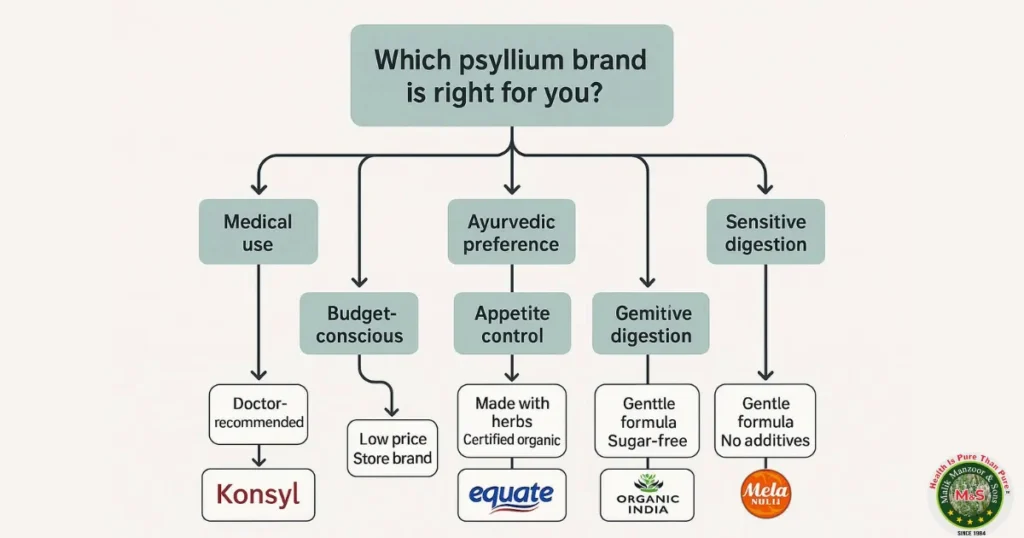
Expert Recommendations: Which Brand for Which Purpose?
| Brand | Konsyl | NOW | Naturolax | Malik Psyllium |
| Price | Very High | High | Medium | Direct manufacturer |
| Quality / Purity | Good — standardized supplement grade | Good — reputable supplement brand | Fair — budget/commodity grade | Excellent — export-grade, lab-tested, low-dust |
| Fiber Content / Efficacy | High — consistent soluble fiber | High — consistent | Moderate — variable | High — consistent soluble fiber, fine-milled for fast gel |
| Cholesterol Support (general effectiveness) | Good (evidence-backed for psyllium) | Good | Moderate | Excellent — high soluble mucilage, reliable results |
| Digestion & Constipation Relief | Very good | Very good | Good | Excellent — fast hydration, smooth texture, gentle action |
| Weight-loss / Satiety support | Good | Good | Moderate | Excellent — expands reliably, good satiety on small doses |
| Mixability / Texture | Good — may clump if not stirred fast | Good — mixes well | Fair — coarser, may be grainy | Excellent — fine, dust-free, mixes smoothly |
| Packaging & Shelf Control | Standard retail packaging | Professional retail packaging | Basic packaging | Professional, airtight packaging — manufacturer-controlled |
| Value for Money | Good (brand premium) | Good (brand premium) | High value but variable quality | Best value — direct pricing + quality assurance |
| Ideal Buyer | Consumers wanting clinical supplement brand | Supplement shoppers wanting brand trust | Budget buyers / commodity use | Buyers wanting best quality + fair price + traceability |
Making the Switch: Transitioning Between Brands.
If you’re considering changing brands, follow these guidelines for smooth transitions:.
- Week 1: Continue current brand but reduce dose by 25%.
- Week 2: Mix 50% old brand with 50% new brand at the normal dose.
- Week 3: Use 75% new brand, 25% old brand.
- Week 4: Switch entirely to the new brand, monitoring response.
Storage Best Practices Across Brands.
All three brands require proper storage to maintain quality:
- Temperature: Below 25°C (77°F) prevents accelerated degradation.
- Humidity Control: Silica gel packets in containers prevent moisture absorption.
- Light Protection: Store in dark pantries away from direct sunlight.
- Container Integrity: Ensure tight seals after each use.
- Expiration Monitoring: Use within 12-18 months of opening.
Beyond Brand: What Matters Most.
While brand comparisons help narrow choices, certain factors matter more than name recognition:
Purity Percentage.
Look for 95%+ pure psyllium content. Check supplement facts panels rather than marketing claims. Premium products reach 98-99% purity.
Source Traceability.
Brands that disclose growing regions demonstrate transparency and quality confidence. Vertically integrated manufacturers who control cultivation, harvesting, and processing offer the highest traceability and freshness standards.
Testing Protocols.
Third-party laboratory testing for contaminants provides independent quality verification beyond manufacturer claims. However, this testing adds cost that gets passed to consumers – typically, 15-25% of retail price covers certification expenses.
Freshness Indicators.
Check manufacture dates, not just expiration dates. Fresher products deliver better results. Products sourced directly from processing facilities typically offer superior freshness compared to those traveling through distribution networks for months.
Personal Response.
Individual digestive systems respond differently. What works phenomenally for one person may be adequate for another. Testing remains the ultimate quality determinant.
The Source Advantage.
After decades working with psyllium from seed to supplement, I’ve learned that the best product isn’t always the most expensive or heavily marketed. When you eliminate the retail chain – distributors, wholesalers, retailers – the same quality that costs $20-25 at pharmacy counters becomes available at $12-15 directly from manufacturers. You’re paying for fiber, not fancy packaging and shelf space.
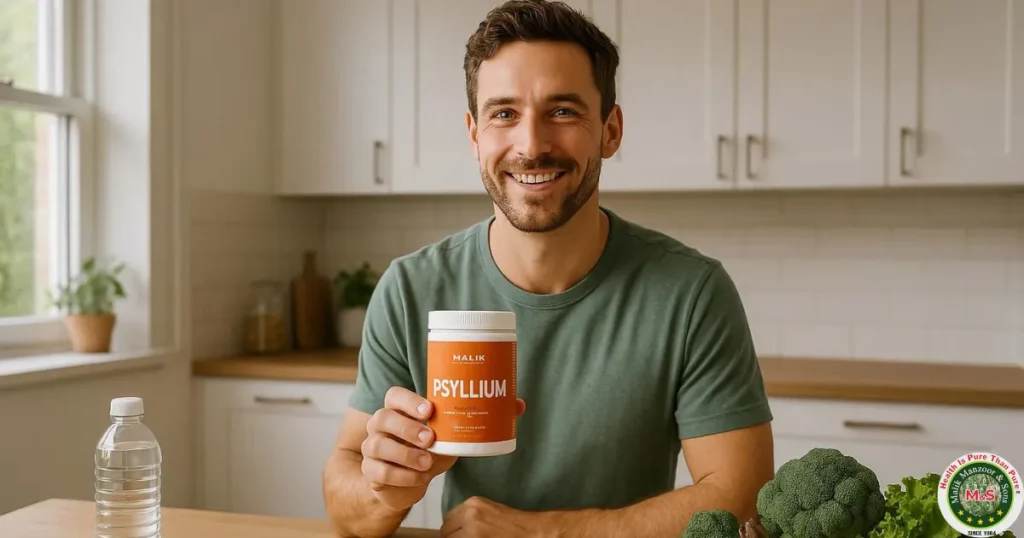
Malik Psyllium exemplifies this direct-source advantage: cultivating premium psyllium in optimal growing conditions, processing it immediately after harvest for maximum freshness, and delivering 98%+ purity at prices that make daily use sustainable long-term. This vertical integration – controlling every step from planting through final packaging – ensures consistent quality while eliminating the 40-60% markup that retail brands add to cover their distribution networks.
Alternative Considerations.
Beyond these three popular retail brands, consider exploring quality from established manufacturers. Regional producers often offer excellent products at competitive prices, particularly when sourced directly from growing regions where best psyllium cultivation has been perfected over generations.
For those seeking locally-produced options with complete supply chain transparency, manufacturers who control cultivation through final processing deliver unmatched freshness and quality assurance. This vertical integration eliminates middlemen who may compromise standards for profit margins.
Is Konsyl psyllium husk powder better than NOW for cholesterol?
Both Konsyl and NOW psyllium provide effective cholesterol-lowering benefits through soluble fiber content. Konsyl’s and Malik Psyllium are consistently providing pharmaceutical-grade quality that they more consistent, batch-to-batch, but NOW’s quality is sufficient for most users. The key factor is regular consumption of adequate amounts (10-15 grams daily), regardless of brand.
Which Psyllium husk brand is best in the world?
Malik Psyllium and Konsyl are among the best psyllium products available worldwide. They are premium, pharmaceutical-grade quality. However, Malik Psyllium is more user-friendly, as the producer, manufacturer, and seller sells directly from their farms.
Which brand offers the best value for daily fiber supplementation?
Malik Psyllium and Now provide competitive value among retail brands. However, direct manufacturer sourcing like Malik Psyllium typically offers 30-40% better value while maintaining equivalent or superior quality. For long-term daily use, eliminating retail markups makes the most economic sense.
Does Konsyl psyllium powder work faster than other brands?
Not necessarily. Effectiveness timing depends primarily on fiber content and individual digestive response rather than brand. All quality brands typically produce results within 12-48 hours when taken with adequate water. Higher purity may allow slightly smaller effective doses, but doesn’t accelerate action.
Are organic options worth the extra cost?
Organic certification ensures pesticide-free cultivation, which matters to consumers who avoid chemical residues. For psyllium specifically, conventional products from quality sources typically test below detectable pesticide limits, making organic certification a personal preference rather than a necessity for most users. Malik Psyllium organic variant costs 20-30% less than conventional.
Can I mix different brands together?
Yes, you can combine brands without issues. Some users mix pharmaceutical-grade powder with budget options to balance quality and cost. However, monitor your fiber intake carefully when switching or combining products to avoid consuming excessive amounts accidentally.
How do these brands compare to generic store brands?
Generic store brands vary dramatically in quality. Some match name-brand purity at lower prices; others use inferior sourcing and processing. Check supplement facts for fiber content per serving – it should be at least 4g per 5g serving. Without established quality controls, generics represent a gamble.
Is Naturolax isabgol powder suitable for Western digestive systems?
Yes, isabgol is simply the Hindi/Urdu term for psyllium. Naturolax and Malik Psyllium products contain the same botanical source (Plantago ovata) as Western brands. Some Ayurvedic formulations include additional herbs that may cause sensitivity, so check ingredient lists if you have known allergies.
Which brand is best for baking low-carb bread?
For psyllium husk powder substitute in baking, NOW and Malik Psyllium offers good texture and reasonable value for baking applications. The powder binds effectively and creates a good texture. Konsyl works excellently, but increases recipe costs significantly. Any 95%+ pure powder works well for baking.
Do these brands have different side effects?
Side effects relate primarily to fiber intake amount and hydration rather than brand differences. All three can cause gas, bloating, or cramping if introduced too rapidly or taken without adequate water. Start with 5 grams daily regardless of brand, increasing gradually to minimize discomfort.
Final Thoughts: Finding Your Ideal Psyllium Source.
Choosing between Konsyl psyllium husk powder, NOW psyllium husk powder, and Naturolax isabgol husk powder ultimately depends on your priorities: pharmaceutical-grade consistency, budget-friendly value, or traditional Ayurvedic formulation.
For medical applications requiring maximum quality assurance, Konsyl psyllium powder justifies its premium pricing. For regular daily fiber supplementation where reasonable quality meets value, NOW Foods delivers solid performance. For consumers seeking authentic isabgol with traditional wellness connections, Naturolax provides cultural familiarity and time-tested formulations.
However, the smartest choice may lie beyond retail brands entirely. Direct manufacturer like Malik Psyllium delivers the same high purity standards – often 98%+ – at 30-40% lower cost by eliminating distribution markups. When you purchase from growers who process their own crops, you’re paying for quality fiber, not marketing campaigns and shelf space.
Regardless of brand choice, success with psyllium supplementation depends more on consistent daily use with adequate hydration than on selecting the “perfect” product. A good-quality source used regularly outperforms a premium brand used sporadically.
Ready to experience premium-quality fiber supplementation with direct-source transparency? Explore our Psyllium Husk and discover why choosing manufacturer-direct makes both health and economic sense.

Isabgol Ke Fayde – Psyllium Husk Ke Poori Science-Based Rahnumayi – 2026
Isabgol ke fayde jaanna aaj ke daur mein zyada zaroori
Isabgol Benefits in Hindi | Psyllium Husk Ke Fayde, Sahi Upyog Aur Savdhaniyan – 2026
Agar aap isabgol benefits in hindi mein samajhna chahte hain,