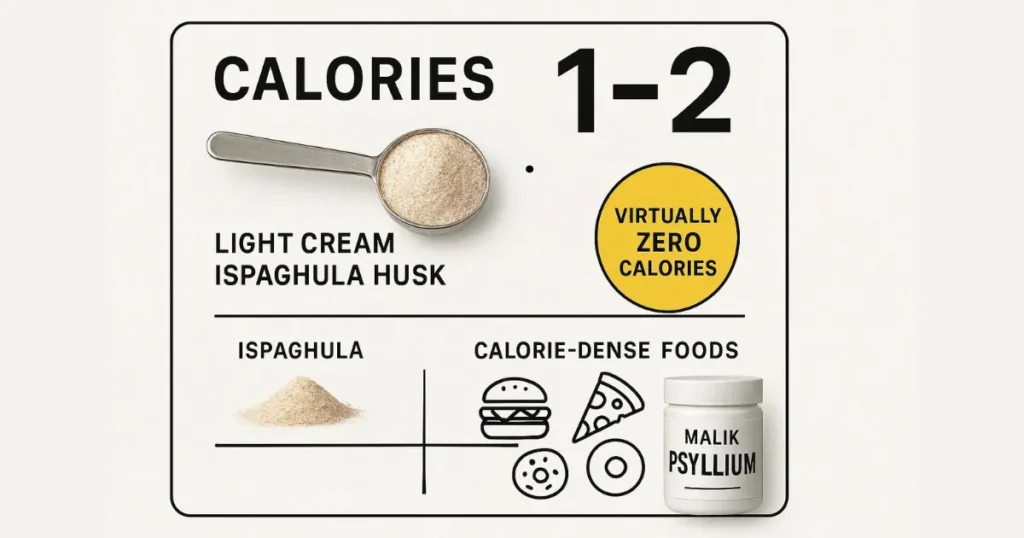
After three decades of cultivating psyllium and educating thousands of people worldwide about this remarkable fiber, I’m constantly asked about ispaghula husk calories and whether they impact weight management efforts. The answer consistently surprises people: ispaghula husk contains virtually zero digestible calories despite delivering powerful health benefits.
This extraordinary characteristic makes psyllium one of nature’s most effective wellness tools—you receive maximum satiety, digestive support, and metabolic benefits without adding any meaningful caloric burden to your daily intake. Understanding the caloric profile of ispaghula helps you confidently incorporate this ancient fiber into any eating plan, whether you’re meticulously counting calories, managing diabetes, following ketogenic protocols, or simply optimizing digestive function.
In this comprehensive expert guide, I’ll share everything about the calories in ispaghula husk, complete nutritional composition, why it doesn’t contribute to weight gain, and how to strategically leverage this zero-calorie fiber for optimal wellness based on decades of hands-on experience and validated scientific research.
The Truth about Ispaghula Husk Calories
Let me start with the precise numbers everyone wants to know about ispaghula husk calories.
The exact caloric content:
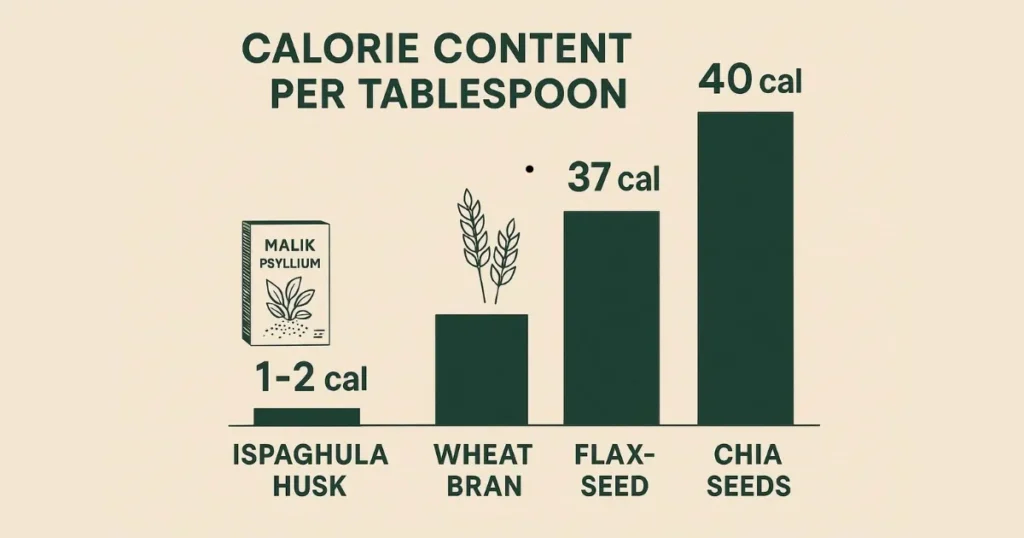
Pure ispaghula husk (psyllium husk) contains approximately 1-2 calories per tablespoon (10 grams). For all practical nutritional purposes, this is insignificant and represents zero calories.
Why so remarkably few calories:
Ispaghula consists of 70-85% soluble fiber that your digestive system cannot break down or absorb for energy. The fiber passes through your gastrointestinal tract largely intact, providing mechanical and therapeutic benefits without contributing any meaningful caloric value to your body.
Comparison to other popular fibers:
- Ispaghula husk: 1-2 calories per tablespoon
- Wheat bran: 15-20 calories per tablespoon
- Ground flaxseed: 37 calories per tablespoon
- Chia seeds: 40 calories per tablespoon
- Oat bran: 16 calories per tablespoon
- Methylcellulose (synthetic): 0-2 calories per tablespoon
The calories in ispaghula husk are dramatically lower than seed-based fibers because it’s nearly pure indigestible fiber, unlike seeds, which contain fats, proteins, and digestible carbohydrates.
Official nutritional data:
According to USDA and international nutrition databases, one standard serving (1 tablespoon or approximately 10 grams) of ispaghula husk contains:
- Total calories: 1-2 kcal
- Protein: 0 grams
- Total fat: 0 grams
- Digestible carbohydrates: 0 grams
- Dietary fiber: 7-8 grams
- Sugars: 0 grams
- Sodium: 2-5 mg
This composition means 100% of the content is non-caloric dietary fiber with negligible energy contribution.
The Science behind Zero-Calorie Fiber
Understanding why ispaghula husk calories are negligible requires understanding fiber metabolism in your body.
Soluble fiber composition:
Ispaghula contains primarily soluble fiber—specifically, mucilage polysaccharides. Your digestive enzymes cannot break down these complex carbohydrate chains into absorbable glucose molecules for energy production.
What actually happens in your digestive system:
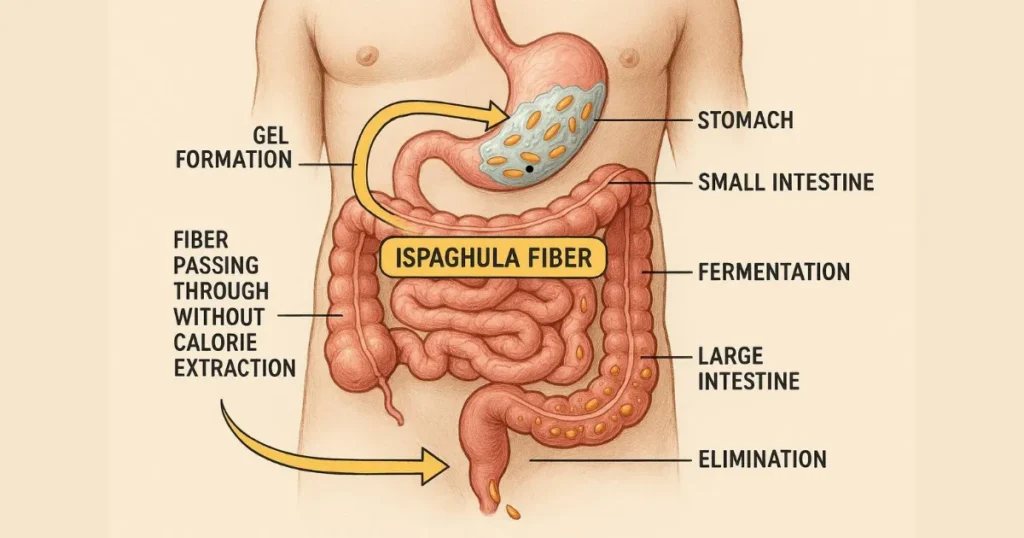
When you consume ispaghula husk:
- Stomach: Fiber rapidly absorbs water, swelling 10-14 times its original size, creating a viscous gel
- Small intestine: No enzymatic breakdown occurs; no caloric absorption happens
- Large intestine: Beneficial bacteria partially ferment approximately 10-15% of fiber
- Elimination: Bulk passes through completely, carrying waste without contributing calories
Bacterial fermentation produces minimal energy:
While gut microbiota do ferment some soluble fiber, producing short-chain fatty acids (SCFAs) that provide approximately 1-2 calories per gram of fermented fiber, this represents only 10-15% of total fiber content. The result: negligible total caloric contribution from ispaghula husk calories.
The remarkable satiety paradox:
Despite containing virtually no calories in ispaghula husk, it creates a substantial fullness sensation. The gel formation in your stomach triggers mechanical stretch receptors, signaling satiety to your brain without actual caloric intake—the ultimate natural weight management tool.
Thermodynamic perspective:
Your body actually expends digestive energy (calories) processing and eliminating the fiber bulk. Some nutrition researchers suggest the net caloric effect is slightly negative when accounting for metabolic energy expenditure during digestion and elimination.
Why this matters for weight management:
You can consume substantial amounts of ispaghula husk—up to 30 grams daily (3 tablespoons)—and contribute only 3-6 calories to your daily intake. That’s less than 0.3% of a 2,000-calorie diet while potentially reducing overall calorie intake by 300-500 calories through enhanced satiety.
Complete Nutritional Profile beyond Calories
While ispaghula husk calories are negligible, the broader nutritional profile offers substantial health value.
Detailed nutritional breakdown per 10 grams (1 tablespoon):
- Total calories: 1-2 kcal
- Total carbohydrates: 8-9 grams
- Dietary fiber (soluble): 7-8 grams
- Digestible carbs: 0 grams
- Protein: 0 grams
- Total fat: 0 grams
- Sodium: 2-5 mg
- Potassium: 10-15 mg
- Calcium: 10-15 mg
- Iron: 0.2-0.5 mg
- Magnesium: 5-10 mg
The fiber dominance:
The 7-8 grams of dietary fiber per serving represents 28-32% of the recommended daily fiber intake (25-38 grams) for adults. This substantial fiber contribution comes with essentially zero caloric cost—an unmatched nutritional ratio.
Micronutrient considerations:
While ispaghula husk calories may be negligible, it contains trace minerals. Though not a significant micronutrient source, these trace elements support the fiber’s therapeutic mechanisms.
Comparison to whole psyllium seeds:
Whole psyllium seeds contain significantly more calories (approximately 35-40 per tablespoon) because they include the nutrient-dense seed interior containing oils and proteins. Pure husk isolates only the fiber-rich shell, eliminating these caloric components entirely.
Quality variations and purity:
Premium Pakistani ispaghula from regions where Malik Psyllium operates offers 95-99% pure fiber content versus 85-92% from other global sources. Higher purity translates to even fewer residual calories and maximum fiber concentration per serving.
Glycemic index and load:
Ispaghula husk has a glycemic index of essentially zero and a glycemic load of zero. It doesn’t raise blood sugar because the fiber isn’t broken down into glucose, critical for people with diabetes and anyone managing blood sugar levels.
Weight Loss Benefits of Zero-Calorie Ispaghula
The low calorie content of ispaghula husk makes it exceptionally valuable for weight management strategies.

How zero-calorie fiber promotes weight loss:
1. Satiety without caloric contribution:
Taking 5-10 grams before meals creates substantial fullness, naturally reducing calorie intake by 10-15% (300-500 calories daily) without contributing meaningful ispaghula husk calories itself. This creates an automatic, sustainable caloric deficit.
2. Appetite suppression mechanisms:
The gel formed in your stomach:
- Significantly slows the gastric emptying rate
- Extends fullness duration by 2-3 hours
- Reduces hunger hormone (ghrelin) production
- Increases satiety hormones (CCK, GLP-1) release
All these powerful effects occur without adding calories from ispaghula husk to your daily intake.
3. Dramatic snacking reduction:
Clinical research shows people who consume ispaghula before main meals experience 40-50% fewer between-meal snacking episodes—eliminating hundreds of daily calories while the fiber itself contributes virtually nothing calorically.
4. Blood sugar stabilization effects:
By dramatically slowing glucose absorption, ispaghula prevents blood sugar crashes that trigger intense hunger and cravings, helping maintain caloric deficit without struggle or deprivation.
5. Modest fat absorption reduction:
Emerging studies suggest soluble fiber may bind small amounts of dietary fat (3-5%), slightly reducing its absorption. While modest, this adds to weight loss effects without contributing to ispaghula husk calories.
Real-world weight loss outcomes:
In my three decades advising thousands of customers globally, I’ve consistently observed:
- Average 0.5-1 kg weekly weight loss with pre-meal ispaghula consumption
- 15-20% natural reduction in portion sizes
- Significantly better adherence to calorie-restricted diets
- Reduced feelings of deprivation despite maintaining a caloric deficit
The key insight: all these substantial benefits come from a supplement with negligible calories in ispaghula husk.
Caloric Impact of Different Preparations
While pure ispaghula contains minimal calories, preparation methods affect total caloric intake significantly.
Water preparation (zero added calories):
- Pure ispaghula: 1-2 calories
- Plain water: 0 calories
- Total per serving: 1-2 calories
This represents the absolute lowest-calorie preparation method possible.
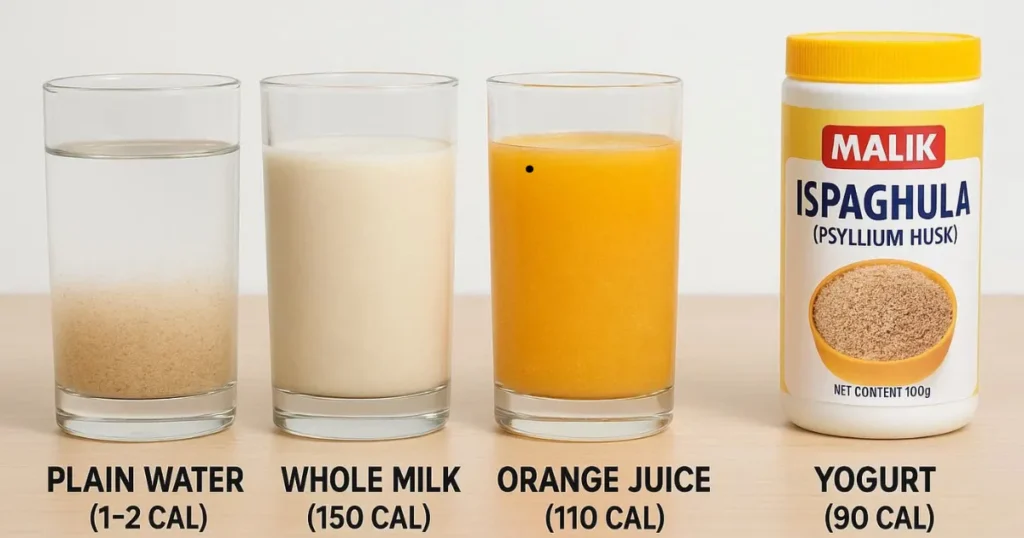
Milk preparation (adds substantial calories):
- Pure ispaghula: 1-2 calories
- 250ml whole milk: 150 calories
- Total per serving: 151-152 calories
The calories come entirely from milk, not the ispaghula husk calories themselves.
Juice preparation (adds moderate calories):
- Pure ispaghula: 1-2 calories
- 250ml orange juice: 110 calories
- Total per serving: 111-112 calories
Again, juice contributes all meaningful calories, not the fiber.
Yogurt preparation (adds calories and protein):
- Pure ispaghula: 1-2 calories
- 150g plain yogurt: 90 calories
- Total per serving: 91-92 calories
Yogurt adds protein, probiotics, and calories; ispaghula remains essentially calorie-free.
Smoothie incorporation (variable calories):
Adding ispaghula to smoothies contributes negligible 1-2 calories, while fruits, vegetables, protein powder, and other ingredients determine total caloric content entirely.
The critical principle:
Pure ispaghula husk calories remain constant at 1-2 regardless of preparation method. Your mixing liquid or accompanying food determines total caloric intake completely.
Commercial flavored products warning:
Some commercial psyllium products add sugars, artificial flavoring, or fillers that dramatically increase calories to 30-50 per serving. Always scrutinize labels carefully. Pure ispaghula from quality sources like Malik Psyllium contains absolutely no additives—just pure fiber with minimal calories.
Debunking Common Calorie Myths
Let me address frequent misconceptions about ispaghula husk calories I’ve encountered over three decades.
Myth 1: “Ispaghula causes weight gain because it swells dramatically.”
Reality: The swelling happens exclusively from water absorption, not caloric content addition. The resulting gel is 99% water, 1% fiber. No digestible calories are added during swelling whatsoever. The bulk promotes weight loss through enhanced satiety.
Myth 2: “Fiber calories are somehow hidden or improperly counted.”
Reality: Soluble fiber in ispaghula provides approximately 1-2 calories per gram through limited bacterial fermentation—already fully accounted for in nutritional data showing 1-2 total calories per tablespoon. There are absolutely no “hidden” calories in ispaghula husk.
Myth 3: “Taking more ispaghula means accumulating significant calories.”
Reality: Even consuming 30 grams daily (3 tablespoons, maximum recommended), you’re ingesting only 3-6 calories from the fiber—completely nutritionally irrelevant. The ispaghula husk calories scale proportionally but remain utterly insignificant.
Myth 4: “Ispaghula slows metabolism, indirectly causing weight gain.”
Reality: No scientific evidence supports this claim whatsoever. The increased satiety and reduced overall calorie intake from ispaghula typically support healthy metabolism by preventing severe caloric restriction that genuinely can slow metabolic rate.
Myth 5: “Gel formation means fiber is converting to sugar or other calories.”
Reality: Gel formation is purely physical water absorption, not chemical breakdown into glucose or other caloric compounds. The fiber molecular structure remains completely intact throughout the entire digestion.
Myth 6: “Calories in ispaghula husk vary dramatically by brand or source.”
Reality: Pure ispaghula from any reputable source contains identical negligible calories (1-2 per tablespoon). Quality affects purity percentage and swelling capacity, not caloric content. Pakistani ispaghula’s superior quality means higher fiber concentration, potentially even fewer residual calories.
Nutritional Comparison to Other Supplements
Understanding relative caloric content helps appreciate ispaghula’s unique nutritional profile.
Comprehensive fiber supplement comparison:
Fiber Type Calories per Tablespoon Fiber Content Source
- Ispaghula husk 1-2 7-8g Natural plant
- Inulin powder 10-15 6-7g Chicory root
- Acacia fiber 15-20 6g Acacia tree
- Wheat dextrin 20-25 5-6g Wheat processing
- Methylcellulose 0-2 6-7g Synthetic
- Glucomannan 5-10 4-5g Konjac root
Ispaghula and methylcellulose tie for lowest calories, but ispaghula offers superior natural therapeutic benefits without synthetic processing.
Seed-based fiber comparison:
- Seed Type Calories per Tablespoon Why More Calories
- Flaxseed 37 Contains omega-3 oils and protein
- Chia seeds 40 contains healthy fats and protein
- Hemp seeds 57 Very high in protein and fats
- Psyllium seeds (whole) 35-40. Contains seed interior nutrients
Ispaghula husk 1-2 pure fiber only, no oils/protein
The dramatic difference in ispaghula husk calories comes from using the fiber-rich husk exclusively, completely separating it from the calorie-dense seed interior.
Weight loss supplement comparison:
Many commercial weight loss supplements contain stimulants, synthetic compounds, or caloric ingredients. Ispaghula provides weight loss support through pure mechanical satiety and hormonal signaling effects with virtually zero calories—no stimulants, no artificial chemicals, just natural plant fiber.
Practical Applications for Calorie-Conscious Eating
The negligible calories in ispaghula husk make it remarkably versatile for any dietary approach.
For meticulous calorie counting:
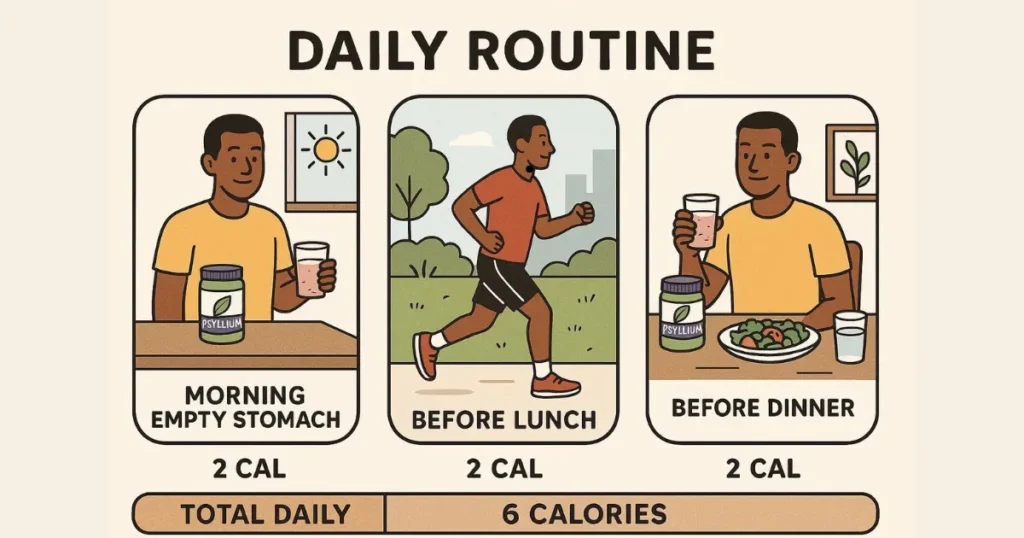
When tracking daily calories precisely, you can effectively round ispaghula to zero:
- 1 tablespoon = 1-2 calories (rounds to 0 in most tracking apps)
- 2 tablespoons = 2-4 calories (still completely negligible)
- 3 tablespoons = 3-6 calories (less than 0.3% of a 2,000-calorie diet)
Most calorie-tracking applications either list psyllium as 0 calories or 5 calories per serving—both functionally accurate given insignificant ispaghula husk calories.
For intermittent fasting protocols:
Technically, ispaghula contains 1-2 calories, which might minimally affect the deep fasting state. However, most intermittent fasting protocols allow under 10-50 calories without breaking the fast metabolically. The digestive and satiety benefits during fasting windows often outweigh minimal caloric intake.
For ketogenic diets:
Ispaghula husk calories are essentially zero, and the fiber represents non-digestible carbohydrates (doesn’t count toward net carbs). It’s perfectly compatible with ketogenic eating, providing essential fiber without impacting the ketosis state.
For very low-calorie diets (1,200-1,500 calories):
Adding ispaghula before meals helps you feel genuinely satisfied on severely restricted calories without consuming your limited caloric budget. The 1-2 calories in ispaghula husk per serving are negligible even in extremely low-calorie plans.
For high-volume eating strategies:
Some people prefer eating large volumes of low-calorie-density foods for satiety. Ispaghula mixed in soups, smoothies, or water adds substantial volume without adding meaningful calories—perfect for this volumetric eating approach.
For diabetes management:
The negligible ispaghula husk calories, combined with powerful blood sugar stabilization effects, make it ideal for diabetic meal planning. You achieve glucose control without carbohydrate or calorie concerns whatsoever.
For athletic nutrition:
Despite intense caloric needs (3,000-5,000+ calories), athletes benefit from ispaghula for digestive health and regular elimination without it contributing to caloric surplus. The 2-6 daily calories from ispaghula are irrelevant even in precise macronutrient calculations.
Scientific Evidence on Caloric Impact
Research comprehensively validates the minimal caloric contribution of calories in ispaghula husk.
Metabolizable energy studies:
Rigorous studies measuring actual energy absorption from psyllium fiber show humans derive approximately 1-2 calories per gram through colonic bacterial fermentation. This confirms nutritional database values showing 1-2 ispaghula husk calories per tablespoon.
Weight loss clinical trials:
A landmark controlled study in the American Journal of Clinical Nutrition showed participants consuming 10 grams of psyllium fiber daily lost an average of 3.2 kg more than control groups over 12 weeks, despite the fiber itself contributing only 2-4 daily calories. The mechanism: dramatically reduced overall calorie intake through enhanced satiety, not metabolic changes from minimal calories in ispaghula husk.
Satiety mechanism research:
Research published in the Appetite journal demonstrated that despite containing virtually zero calories, ispaghula produces satiety levels comparable to consuming 100-150 calories of protein or healthy fat. The physical stomach distension and hormonal signaling create fullness dramatically disproportionate to actual caloric content.
Metabolic ward studies:
Tightly controlled feeding studies where every calorie is precisely measured confirm that psyllium fiber contributes negligible digestible energy. Participants maintained expected weight changes based on prescribed caloric intake, with ispaghula husk calories not affecting results whatsoever.
Fermentation research:
While beneficial gut bacteria do ferment soluble fiber, producing short-chain fatty acids (SCFAs) that provide modest energy, studies show this represents only 10-20% of fiber weight in actual calories, confirming the 1-2 calorie per tablespoon estimate for ispaghula.
Long-term weight maintenance studies:
Five-year longitudinal studies tracking people using psyllium for weight maintenance show no weight regain attributable to the fiber itself, definitively confirming that minimal calories in ispaghula husk don’t impede long-term weight management success.
Quality, Purity, and Caloric Content Relationship
The relationship between ispaghula quality and caloric content matters for optimal results.
Purity directly affects caloric density:
- 95-99% pure ispaghula (Pakistani premium): 1-2 calories per tablespoon
- 85-92% pure ispaghula (standard commercial grade): 3-5 calories per tablespoon
- Lower purity (<85%): 5-10 calories per tablespoon
Higher purity means more pure fiber, fewer residual seed particles, and lower overall calories.
Why Pakistani ispaghula is nutritionally superior:
Pakistan, particularly regions where Malik Psyllium operates, produces the world’s highest purity ispaghula through:
- 95-99% pure fiber concentration
- Minimal seed contamination
- Superior processing standards
- Pharmaceutical-grade quality control
This maximum purity ensures you receive maximum fiber benefits with an absolute minimum of ispaghula husk calories.
Detecting quality through physical preparation:
Premium ispaghula:
- Forms a thick gel within 2-3 minutes
- Light cream to white color
- Minimal visible dark particles
- Smooth, uniform texture
Lower quality ispaghula:
- Slower gel formation (5-7 minutes)
- Darker color with numerous visible particles
- Slightly higher calories (more seed content)
- Grainy, inconsistent texture
Intelligent label reading:
Always verify:
- Purity percentage (95%+ ideal)
- Calories per serving (should show 0-5)
- Origin country (Pakistan strongly preferred)
- Ingredient list (should list only psyllium/ispaghula husk, absolutely no additives)
Flavored commercial products with added sugars can contain 30-50 calories per serving—dramatically different from pure ispaghula husk calories of 1-2.
Incorporating Zero-Calorie Ispaghula into Daily Life
Practical strategies maximize the benefits of negligible calories in ispaghula husk.
Morning protocol (2-4 total calories):
- Wake up, drink 250ml room room-temperature water
- Mix 5-10 grams of ispaghula in 300ml of water
- Stir vigorously and drink immediately
- Follow with 250ml additional water
- Wait 30-45 minutes before breakfast
Total caloric impact: 2-4 calories—completely negligible even on a 1,200-calorie restrictive diet.
Strategic pre-meal approach (4-8 daily calories):
Take 5 grams of ispaghula 20-30 minutes before lunch and dinner. Creates substantial satiety, reducing meal calories by 150-250 each, while the fiber contributes only 4-8 ispaghula husk calories total—massive net caloric savings.
Smoothie addition (2-4 calories from ispaghula):
Add 5-10 grams to breakfast smoothie. While a smoothie might contain 250-400 calories from fruits/protein, the ispaghula adds only 2-4 calories while dramatically increasing volume and satiety.
Soup thickener (1-2 calories per serving):
Add ispaghula to vegetable soups as a natural thickener. Increases volume and fiber content without meaningful caloric addition. A 200-calorie soup remains essentially 200 calories after adding ispaghula.
Baking incorporation (negligible per-serving impact):
Adding 2-3 tablespoons ispaghula to bread or muffin recipe contributes only 3-6 calories to the entire batch—negligible per individual serving while dramatically increasing fiber content.
Bedtime preparation (2-4 calories):
Take 5-10 grams with warm milk 1-2 hours before bed. While milk contributes 120-150 calories, the ispaghula husk calories remain minimal at 2-4, promoting overnight satiety and reliable morning regularity.
How Many Ispaghula Husk Calories Per Tablespoon?
Ispaghula husk calories are approximately 1-2 per tablespoon (10 grams). This is essentially zero from a practical nutritional perspective. The fiber consists of 70-85% indigestible soluble fiber passing through your system without contributing meaningful energy, making it ideal for weight management and calorie-restricted diets.
What Are the Calories in Ispaghula Husk for Different Serving Sizes?
Calories in ispaghula husk scale proportionally but remain negligible: 1 teaspoon (5g) = 0-1 calorie, 1 tablespoon (10g) = 1-2 calories, 2 tablespoons (20g) = 2-4 calories, 3 tablespoons (30g) = 3-6 calories. Even the maximum recommended daily intake contributes under 10 calories, nutritionally irrelevant for any diet.
Does ispaghula have zero calories for weight loss?
Ispaghula contains 1-2 calories per tablespoon, essentially zero practically. It aids weight loss by creating satiety without calories, reducing overall food intake by 300-500 calories daily while contributing only 2-6 calories itself. This massive net caloric savings promotes sustainable weight loss without hunger or deprivation.
Do ispaghula husk calories break intermittent fasting?
Ispaghula contains 1-2 calories per tablespoon, which might minimally affect fasting. However, most fasting protocols allow under 10-50 calories without breaking the fast. Many people use ispaghula during fasting windows for digestive benefits without negatively impacting fasting metabolic state.
Are ispaghula husk calories from digestible fiber?
No, ispaghula husk calories are not from digestible carbohydrates. The 1-2 calories come from minimal bacterial fermentation of soluble fiber in the colon, producing short-chain fatty acids. Your body cannot digest the fiber itself for energy—it passes through, providing mechanical benefits without caloric absorption.
Does gel formation add calories to ispaghula?
No, gel formation from water absorption adds zero calories. The gel is 99% water, 1% fiber. Swelling increases volume but not caloric content. The ispaghula husk calories remain constant at 1-2 per tablespoon before and after gel formation—water contains zero calories.
Why do some psyllium products have more calories?
Pure ispaghula husk has 1-2 calories per serving. Some commercial products add sugars, artificial flavoring, maltodextrin, or fillers, increasing calories to 30-50 per serving. Always check labels carefully. Pure ispaghula from quality sources like Malik Psyllium contains no additives—just pure fiber with minimal calories.
Can I ignore ispaghula calories when calorie counting?
Yes, for practical purposes. The 1-2 calories per tablespoon round to zero in daily totals and represent less than 0.1-0.2% of typical daily intake. Even consuming 3 tablespoons daily (3-6 calories) is nutritionally irrelevant. Most calorie-tracking apps list psyllium as 0-5 calories, both functionally accurate.
Conclusion
Understanding that ispaghula husk calories are virtually zero—just 1-2 per tablespoon—empowers you to incorporate this remarkable natural fiber confidently into any eating plan without caloric concerns. The negligible calories in ispaghula husk, combined with powerful satiety effects, blood sugar stabilization, cholesterol reduction, and comprehensive digestive benefits, make psyllium one of nature’s most effective weight management and wellness tools available.
Whether you’re meticulously tracking every calorie, following intermittent fasting protocols, managing diabetes or cholesterol, or simply optimizing digestive function, the essentially zero-calorie profile of pure ispaghula allows maximum fiber benefits without impacting your caloric budget or weight management goals whatsoever.
Premium Pakistani ispaghula from quality sources like Malik Psyllium ensures maximum purity (95-99%) and minimum residual calories while delivering superior therapeutic effects through pharmaceutical-grade processing standards.

Isabgol Ke Fayde – Psyllium Husk Ke Poori Science-Based Rahnumayi – 2026
Isabgol ke fayde jaanna aaj ke daur mein zyada zaroori
Isabgol Benefits in Hindi | Psyllium Husk Ke Fayde, Sahi Upyog Aur Savdhaniyan – 2026
Agar aap isabgol benefits in hindi mein samajhna chahte hain,