When people search for the psyllium husk common name, they’re often confused by the numerous terms used globally– ispaghula, isabgol, plantago, blonde psyllium, and more. Understanding the psyllium husk meaning and its various names helps you identify quality products, communicate with suppliers, and navigate health information accurately.
This comprehensive guide clarifies all the names associated with this remarkable fiber source, including the psyllium husk botanical name, regional variations, and why these different terms exist. Whether you’re researching for health purposes, comparing products, or simply curious about what “psyllium” actually means, you’ll find clear, authoritative answers that demystify the terminology surrounding this ancient medicinal plant used worldwide.
What is Psyllium Husk? Understanding the Basic Terminology
The psyllium husk common name refers to the outer coating of seeds from Plantago ovata, a medicinal plant cultivated primarily in Pakistan’s Sindh and Punjab provinces. Let me break down what this name actually means.
The Word “Psyllium”.
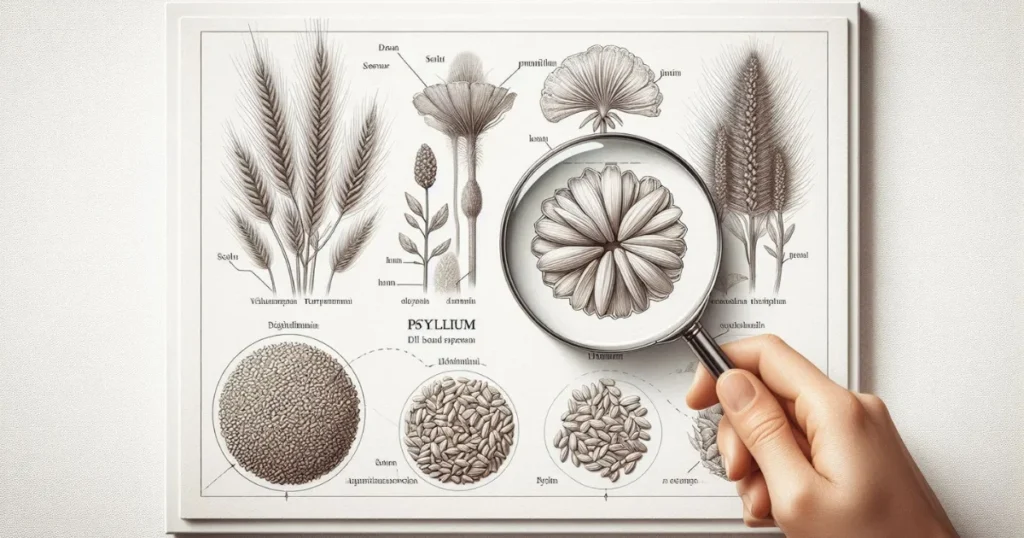
The term “psyllium” comes from the Greek word psylla, meaning “flea.” Early botanists noticed that the tiny, dark brown seeds resembled fleas in size and appearance. This became the basis for the common name used throughout Western medicine and commercial markets.
The Word “Husk”.
“Husk” refers to the outer protective coating of the psyllium seed. This is the part we harvest and process for medicinal and dietary use because it contains the highest concentration of soluble fiber– specifically mucilage– that provides therapeutic benefits.
Why “Common Name” Matters.
In botanical taxonomy, plants have both common names (everyday language) and scientific names (Latin binomial nomenclature). The psyllium husk common name varies by region and language, which can create confusion when purchasing products or reading research studies.
The Psyllium Husk Botanical Name: Scientific Classification.
Understanding the psyllium husk botanical name helps you identify authentic products and avoid confusion with similar plants.

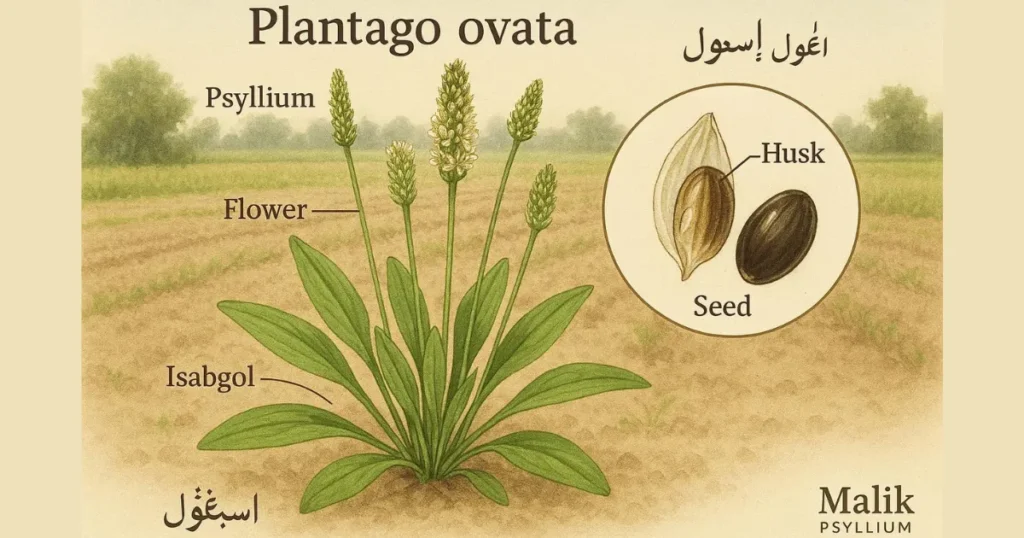
Official Botanical Name: Plantago ovata.
The scientific name consists of two parts:
- Plantago: The genus name, which includes about 200 species of plantain plants.
- Ovata: The species name, referring to the ovate (egg-shaped) leaves of this particular plant.
This binomial nomenclature was established by Swedish botanist Carl Linnaeus and remains constant across all languages and regions, making it the most reliable identifier.
Taxonomic Classification.
- Kingdom: Plantae (Plants).
- Order: Lamiales.
- Family: Plantaginaceae (Plantain family).
- Genus: Plantago.
- Species: P. ovata.
Related Species.
It’s important to distinguish Plantago ovata from related species:
- Plantago psyllium (Black psyllium): Contains less mucilage, inferior quality.
- Plantago major (Common plantain): Used in traditional medicine but not for fiber.
- Plantago lanceolata (Ribwort plantain): Different medicinal properties.
Only Plantago ovata produces the blonde psyllium husk used commercially for digestive health and cholesterol management.
Why Botanical Names Matter.
When researching clinical studies or purchasing products, using the psyllium husk botanical name ensures you’re getting information about the correct species. Some manufacturers use ambiguous terms or blend different plantago species, which affects quality and efficacy.
Psyllium Husk Meaning Across Languages and Regions.
The psyllium husk meaning translates differently across cultures, reflecting diverse traditional medicine systems and regional terminology.

English Names.
- Psyllium husk: Most common in Western markets.
- Blonde psyllium: Distinguishes from black psyllium.
- Plantago seed: Refers to the whole seed.
- Flea seed: Literal translation from the Greek origin.
- Ispaghula husk: British English term borrowed from Hindi/Urdu.
South Asian Names.
- Ispaghula (Hindi/Urdu): The most common term in India, Pakistan, and Bangladesh.
- Isabgol (Hindi/Urdu): Alternative spelling, literally means “horse flower”.
- Isapgol: Simplified spelling variation.
- Ghoda-ghas: Means “horse grass” in some regional dialects.
- Aspagol: Another pronunciation variant.
Middle Eastern and Persian Names.
- Ispaghul: Persian origin of the word.
- Bazr-e-qatuna: Arabic term meaning “flea seed”.
- Asfioos: Used in some Arabic-speaking regions.
European Names.
- Psyllium (French: Psyllium).
- Flohsamen (German: literally “flea seeds”).
- Psillio (Italian).
- Zaragatona (Spanish/Portuguese).
Understanding these variations helps when traveling, communicating with international suppliers, or reading traditional medicine texts from different cultures.
Ispaghula Husk Meaning: Etymology and Cultural Context.
Let me explain the ispaghula husk meaning more deeply, as this term carries significant cultural and historical weight.
Persian Origins.
The word “ispaghula” derives from Persian:
- Isp/Asp: Horse.
- Ghula/Gol: Flower or ear.
The combined meaning “horse flower” or “horse’s ear” refers to the shape of the plant’s flower spike, which resembles a horse’s ear. Persian traders introduced this name throughout South Asia centuries ago.
Traditional Medicine Context.
In Ayurvedic and Unani medicine systems, ispaghula has been used for over 1,000 years. The ispaghula husk meaning in these traditions encompasses:
- Cooling properties (in Ayurvedic doshas).
- Digestive regulator.
- Blood purifier.
- Inflammation reducer.
Modern Usage.
Today, “ispaghula” is the preferred term in:
- Indian Pharmacopoeia.
- British Pharmacopoeia.
- WHO Essential Medicines List.
- Traditional medicine practitioner communities.
When you see “ispaghula” on product labels, it indicates the same plant as “psyllium”– just using the South Asian common name rather than the Greek-derived Western term.
Commercial Names and Product Variations.
Beyond the psyllium husk common name, you’ll encounter various commercial product names in the marketplace.
Branded Product Names.
Many manufacturers create proprietary names:
- Malik Psyllium.
- Konsyl.
- Metamucil.
- Fiberall.
- Reguloid.
- Natural Fiber.
Product Form Variations.
The common name may be modified based on processing:
- Whole psyllium husk: Larger fiber particles.
- Psyllium husk powder: Finely ground.
- Psyllium seed: Whole seeds with husks attached.
- Psyllium husk flakes: Partially processed.
- Blonde psyllium husk: Emphasizes quality grade.
Purity Designations.
You’ll also see terminology indicating quality:
- 95% pure psyllium husk.
- 98% pure ispaghula.
- Pharmaceutical grade psyllium.
- Food grade plantago husk.
At Malik Psyllium, we maintain 98-99% purity standards– the highest available globally.

Why So Many Names? Historical and Geographic Context.
Understanding why the psyllium husk meaning varies across cultures requires looking at historical trade routes and botanical discovery.
Ancient Trade Routes.
Psyllium cultivation began in the Mediterranean region and Persia (modern-day Iran) over 2,000 years ago. As trade routes expanded:
- Persian traders brought seeds to India (introducing the name “ispaghula”).
- Greek physicians documented it as “psyllion” in medical texts.
- Arab traders spread it throughout the Middle East and North Africa.
- European colonizers encountered it in India and adopted local names.
Colonial Medicine.
British colonial physicians working in India learned about ispaghula from Ayurvedic and Unani practitioners. They anglicized the spelling and included it in the British Pharmacopoeia, which is why “ispaghula” remains the official term in British medical literature.
Modern Standardization Attempts.
Today, international health organizations try to standardize terminology:
- WHO: Uses both “psyllium” and “ispaghula” interchangeably.
- FDA: Primarily uses “psyllium”.
- European Medicines Agency: Uses “psyllii testa” (Latin) and “ispaghula”.
Despite standardization efforts, regional preferences persist, which is why knowing multiple names remains practical.
Geographic Distribution and Quality Variations.
The psyllium husk common name often indicates geographic origin, which affects quality.
Pakistani Psyllium.
Pakistan produces approximately 80% of the world’s premium psyllium:
- Primary regions: Sindh and Punjab provinces.
- Climate advantage: Hot, dry summers; mild winters.
- Quality markers: 12-15% mucilage content.
- Common terms: Blonde psyllium, Premium Psyllium, Ispaghula, Isabgol, Ispaghol
Pakistani cultivation benefits from generations of specialized farming knowledge and ideal soil conditions that maximize mucilage production– the key therapeutic component.
Indian Psyllium.
India produces psyllium primarily in:
- Primary regions: Gujarat and Rajasthan.
- Quality variation: 8-10% mucilage content typically.
- Common terms: Isabgol, Indian psyllium.
While Indian psyllium is widely available, quality varies more significantly between batches due to diverse growing conditions and processing standards.
Other Producing Regions.
Small-scale cultivation occurs in:
- Iran: Original cultivation region, limited commercial production.
- Spain: Small quantities for European markets.
- United States: Experimental cultivation, not commercially viable.
For therapeutic applications, Pakistani psyllium consistently demonstrates superior quality, which is why serious manufacturers source exclusively from Pakistan’s premier growing regions.
How to Identify Authentic Psyllium Products.
Knowing the psyllium husk botanical name and common names helps you identify authentic, quality products.
Label Reading Checklist.
Look for these indicators:
- Botanical name: Should state “Plantago ovata”.
- Common name: “Psyllium husk” or “Ispaghula husk”.
- Purity percentage: Minimum 95%, preferably 98%+.
- Origin country: Pakistan, for the highest quality.
- Processing method: Whole husk or powder specified.
- Fiber content: 7-8 grams per tablespoon.
Red Flags to Avoid.
Be cautious if labels show:
- Vague terms like “plantain fiber” (could be a wrong species).
- No botanical name listed.
- “Psyllium blend” (may contain fillers).
- No origin country specified.
- Unusually low pricing (suggests inferior quality).
- No purity percentage given.
Quality Verification.
High-quality psyllium husk powder should have:
- Light blonde to beige color.
- Fine, consistent texture (if powder).
- Mild, slightly nutty aroma.
- Rapid gel formation when mixed with water.
- Swelling index exceeding 40.

Common Misconceptions about Psyllium Names.
Let me clarify frequent misunderstandings about the psyllium husk meaning and terminology.
Myth 1: Psyllium and Ispaghula Are Different Plants.
False. They’re the same plant (Plantago ovata), just different common names from different languages. The psyllium husk common name “psyllium” comes from Greek, while “ispaghula” comes from Persian/Hindi.
Myth 2: “Flea Seed” Means Low Quality.
Not true. “Flea seed” simply refers to the seed’s appearance and is the literal meaning of “psyllium” in Greek. It has no bearing on quality– premium pharmaceutical-grade psyllium is still flea seed by definition.
Myth 3: Black Psyllium Is the Same as Blonde Psyllium.
These are different species. Black psyllium (Plantago psyllium or P. indica) contains less mucilage and is inferior for therapeutic purposes. Blonde psyllium (Plantago ovata) is what you want for health benefits.
Myth 4: All “Plantago” Products Are Equivalent.
The Plantago genus contains over 200 species with very different properties. Only Plantago ovata produces the high-mucilage husk used for digestive health. Other plantago species are used differently in herbal medicine.
Myth 5: The Name Indicates Efficacy.
The commercial name doesn’t determine quality. Whether labeled “psyllium,” “ispaghula,” or “plantago,” efficacy depends on purity, mucilage content, processing quality, and origin– not the terminology used.
Psyllium in Scientific Literature and Research.
When researching health benefits, understanding terminology helps you find relevant studies.
PubMed and Medical Databases.
Search terms that yield results:
- “Plantago ovata” (most comprehensive).
- “Psyllium” (common in Western research).
- “Ispaghula” (British and Indian research).
- “Psyllium fiber” (nutritional studies).
Clinical Trial Terminology.
Most randomized controlled trials use the psyllium husk botanical name “Plantago ovata” to ensure precision, but may also include common names in titles for accessibility.
Pharmacopoeia Standards.
Different pharmacopoeias use different terms:
- USP (United States): “Psyllium Husk”.
- BP (British): “Ispaghula Husk”.
- IP (Indian): “Isabgol”.
- EP (European): “Psyllii testa”.
Research Citation Best Practices.
When citing research, include both the botanical name and common name for clarity: “Psyllium (Plantago ovata) demonstrated …” This ensures readers understand exactly what’s being discussed, regardless of their regional terminology preferences.
Regulatory and Legal Terminology.
The psyllium husk meaning also has legal implications in different regulatory frameworks.
FDA Classifications (United States).
The FDA recognizes:
- Official name: Psyllium husk.
- Botanical source: Plantago ovata seeds.
- Status: Generally Recognized as Safe (GRAS).
- Permitted health claims: Cholesterol reduction, heart disease risk.
FSSAI Standards (India).
India’s food regulator uses:
- Official name: Isabgol husk.
- Botanical name: Plantago ovata.
- Quality standards: Minimum swelling index of 40.
- Purity requirements: Minimum 85%.
European Regulations.
The EU recognizes:
- Official name: Psyllium/Ispaghula husk.
- Botanical designation: Plantago ovata L. seed husk.
- Novel food status: Traditional food (not novel).
- Health claims: Digestive health, cholesterol management.
Import/Export Documentation.
International trade documents typically use HS Code 1211.90 and specify:
- Botanical name for customs classification.
- Common name for commercial identification.
- Origin country.
- Quality grade.
Cultural and Traditional Medicine Perspectives.
The ispaghula husk meaning extends beyond Western nutrition science into traditional healing systems.
Ayurvedic Perspective.
In Ayurveda, ispaghula is classified as:
- Rasa (taste): Sweet, astringent.
- Virya (potency): Cooling.
- Vipaka (post-digestive effect): Sweet.
- Dosha effect: Balances Pitta, calms Vata.
Ayurvedic practitioners use ispaghula for conditions beyond constipation, including inflammation, heat-related disorders, and blood purification.
Unani Medicine View.
Unani medicine, practiced widely in Pakistan and India, considers ispaghula:
- Temperament: Cold and moist.
- Actions: Emollient, demulcent, laxative.
- Primary uses: Digestive cooling, urinary tract soothing.
The Unani perspective emphasizes ispaghula’s cooling properties, making it particularly valuable in hot climates.
Chinese Medicine Adoption.
Though not native to Chinese traditional medicine, modern TCM practitioners have adopted psyllium:
- Chinese name: 洋车前子 (yáng chē qián zǐ).
- Literal meaning: “Foreign plantain seed”.
- Uses: Clearing heat, moistening intestines.
Integration with Modern Medicine.
Today’s evidence-based medicine validates many traditional uses while identifying additional benefits unknown to ancient practitioners, such as cholesterol reduction and blood sugar stabilization.
Practical Tips for Using Different Terminology.
Here’s how to navigate the various names when shopping, researching, or discussing psyllium.
When Shopping Online.
Search multiple terms to find the best options.
- “Psyllium husk” (Western retailers).
- “Ispaghula husk” (South Asian suppliers).
- “Plantago ovata” (specialty health stores).
- “Blonde psyllium” (quality-focused searches).
When Reading Research.
Look for studies using:
- The botanical name in the title or abstract.
- Multiple common names in keywords.
- Specific fiber content measurements (7-8g per tablespoon).
When Communicating with Healthcare Providers.
Use terminology familiar to your provider:
- Western doctors: “Psyllium fiber supplement”.
- Ayurvedic practitioners: “Ispaghula”.
- Nutritionists: “Soluble fiber from Plantago ovata”.
When Ordering Internationally.
Specify clearly:
- Botanical name: Plantago ovata.
- Common name preferences.
- Quality requirements (purity, mucilage content).
- Origin country (Pakistani for premium quality).
The Evolution of Psyllium Nomenclature.
Understanding how the psyllium husk common name evolved helps appreciate its global journey.
Ancient Period (Before 500 CE).
- Used locally in the Mediterranean and Persian regions.
- Known by various local names.
- No standardized nomenclature.
Medieval Period (500-1500 CE).
- Arab physicians documented as “bazr-e-qatuna”.
- Indian Ayurvedic texts mentioned “ispaghula”.
- Limited cross-cultural terminology exchange.
Colonial Period (1500-1900 CE).
- European botanists created the Latin classification.
- British physicians adopted “ispaghula” from Indian use.
- Scientific naming standardized as Plantago ovata.
Modern Era (1900-Present).
- Commercial cultivation expanded in Pakistan and India.
- Western pharmaceutical companies popularized “Psyllium”.
- WHO and international bodies recognize both terms.
- The Internet age enables global terminology awareness.
What is the psyllium husk common name used worldwide?
The most common names are “psyllium husk” in Western countries and “ispaghula” or “isabgol” in South Asia. Both refer to the same plant (Plantago ovata). Other regional names include “flea seed,” “plantago,” and “blonde psyllium”– all describing the outer coating of this medicinal plant’s seeds.
What is the psyllium husk botanical name in scientific classification?
The psyllium husk botanical name is Plantago ovata Forssk. The genus is Plantago, the species is ovata, and it belongs to the Plantaginaceae family. This scientific name remains constant across all languages and ensures accurate identification in research, regulatory documents, and quality products globally.
What does psyllium husk meaning translate to in English?
Psyllium derives from the Greek “psylla,” meaning “flea,” referring to the seed’s size and appearance. “Husk” means the outer seed coating. Together, “psyllium husk” literally means “flea seed coating”– the fiber-rich outer layer that provides therapeutic benefits for digestive health and cholesterol management.
What is the ispaghula husk meaning and origin?
Ispaghula comes from Persian words meaning “horse flower” or “horse’s ear,” referring to the plant’s flower spike shape. This term spread throughout South Asia via ancient trade routes and remains the preferred common name in India, Pakistan, Bangladesh, and traditional Ayurvedic and Unani medicine systems.
Are psyllium and ispaghula the same thing?
Yes, completely identical. Psyllium is the Greek-derived Western name, while ispaghula is the Persian-derived South Asian name for Plantago ovata. They have the same botanical source, fiber content, health benefits, and therapeutic properties– only the terminology differs based on regional and cultural preferences.
Why does psyllium have so many different names?
Multiple names exist due to different languages, trade routes, and traditional medicine systems. Ancient Persians called it “ispaghula,” Greeks used “psyllium,” and various cultures developed local names. Modern commerce and medicine recognize multiple terms, though the botanical name Plantago ovata remains the universal scientific identifier.
How can I identify authentic psyllium husk products by name?
Look for the botanical name “Plantago ovata” on labels, which confirms authentic psyllium. Quality products also specify purity (95 %+), origin country (Pakistan for premium quality), and fiber content (7-8 grams per tablespoon). Avoid vague terms like “plantain fiber” without botanical specification.
What’s the difference between blonde and black psyllium?
Blonde psyllium (Plantago ovata) has 12-15% mucilage content and is the premium therapeutic variety. Black psyllium (Plantago psyllium or P. indica) is a different species with only 8-10% mucilage, making it inferior for health applications. Always choose blonde psyllium from Pakistan for the best results.
Conclusion.
Understanding the psyllium husk common name, including variations like ispaghula and the botanical designation Plantago ovata, empowers you to make informed purchasing decisions and navigate global health information confidently. Whether you encounter this fiber source called psyllium, ispaghula, isabgol, flea seed, or plantago, you now know they refer to the same remarkable plant that’s been supporting digestive health for millennia.
The psyllium husk meaning encompasses both its literal definition– the outer coating of Plantago ovata seeds– and its broader significance across cultures, traditional medicine systems, and modern nutrition science. This terminology knowledge helps you identify authentic, quality products regardless of the naming conventions used by different manufacturers or regions.
Pakistani psyllium, particularly from the Sindh and Punjab provinces, represents the gold standard in quality due to superior mucilage content and generations of cultivation expertise. When selecting products, prioritize botanical accuracy, purity specifications, and origin verification over commercial naming alone.
By recognizing the various names and understanding their cultural, historical, and scientific contexts, you can confidently discuss psyllium with healthcare providers, research its benefits across international studies, and select the highest-quality products for your health goals, regardless of which terminology appears on the label.

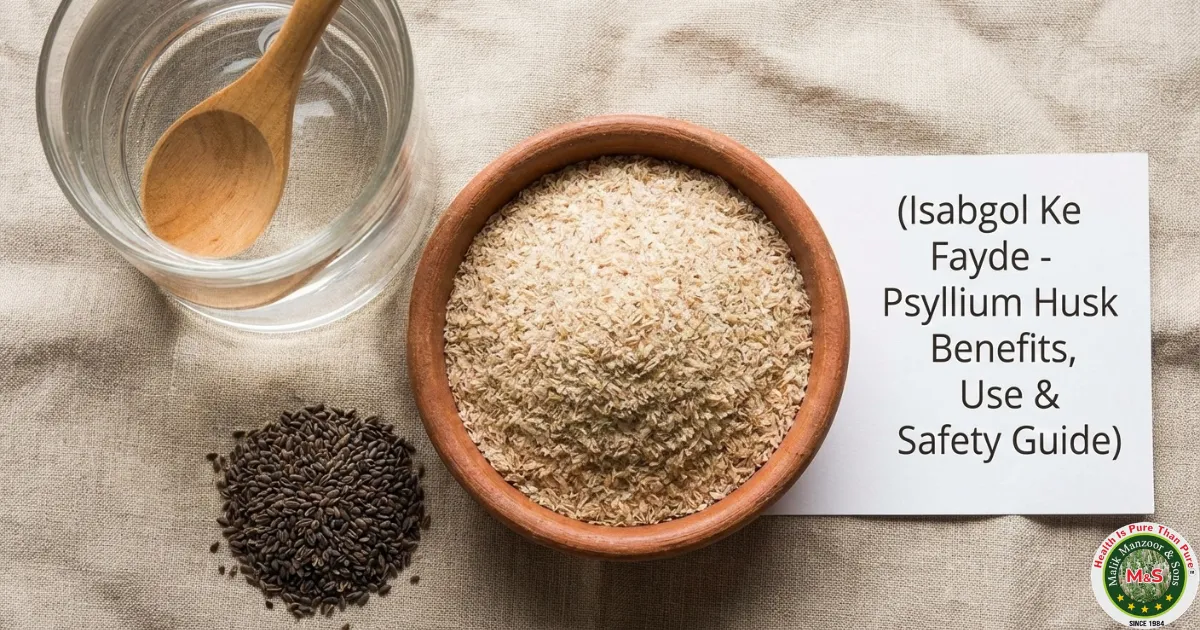
Isabgol Ke Fayde – Psyllium Husk Ke Poori Science-Based Rahnumayi – 2026
Isabgol ke fayde jaanna aaj ke daur mein zyada zaroori
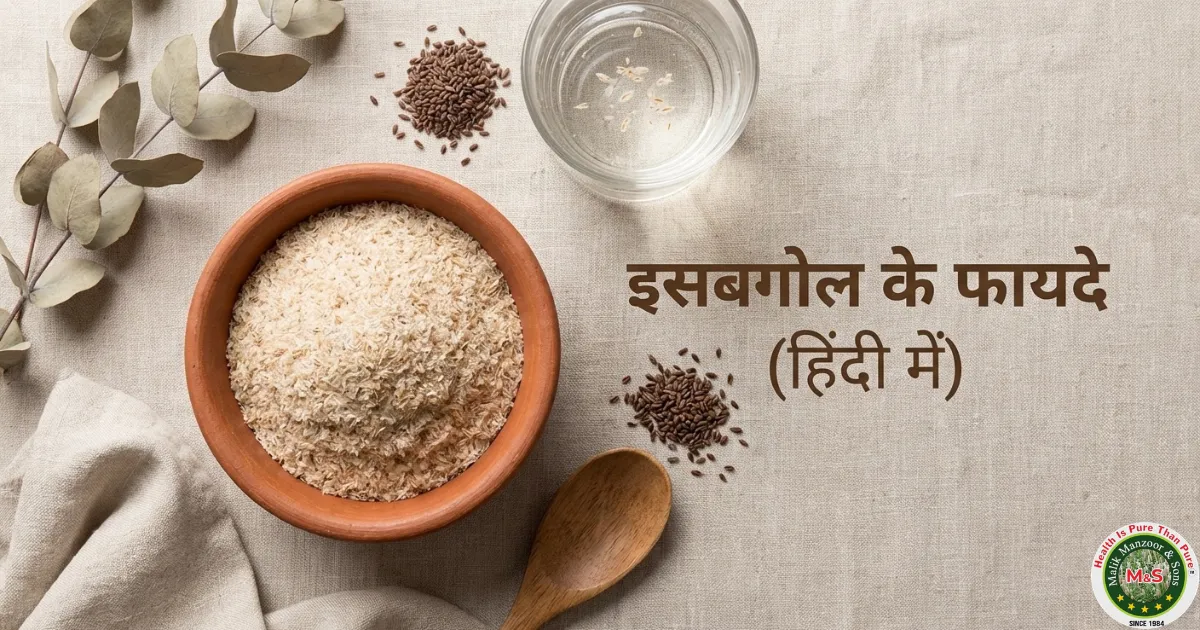
Isabgol Benefits in Hindi | Psyllium Husk Ke Fayde, Sahi Upyog Aur Savdhaniyan – 2026
Agar aap isabgol benefits in hindi mein samajhna chahte hain,