After three decades of cultivating psyllium and answering thousands of questions from health professionals and consumers worldwide, one question consistently emerges: is psyllium husk fiber soluble or insoluble? This question matters tremendously because understanding fiber type determines how psyllium works in your body, what health benefits you can expect, and how to use it most effectively for your specific wellness goals.
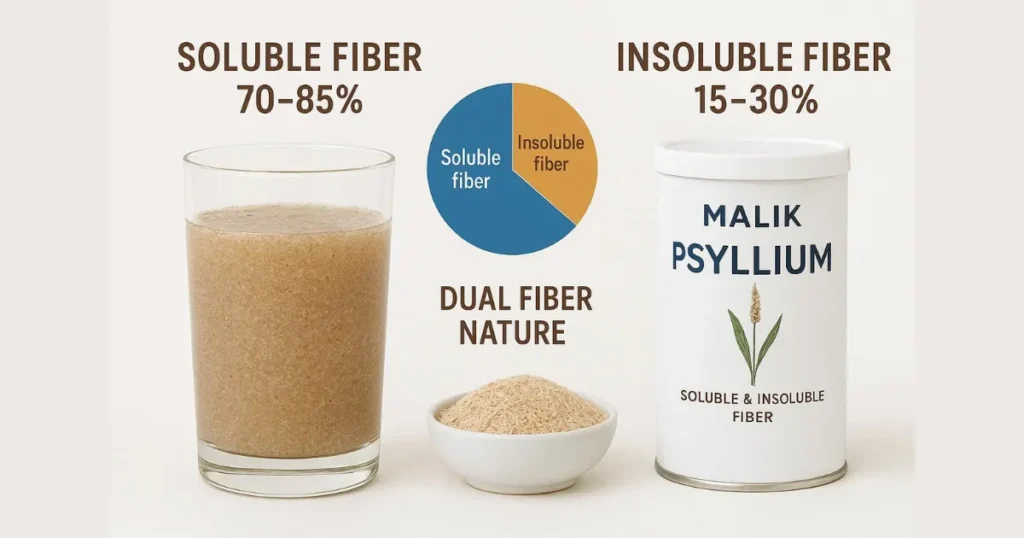
The answer is nuanced and fascinating – psyllium husk contains predominantly soluble fiber (70-85%), but also small amounts of insoluble fiber, creating a unique therapeutic combination that explains its exceptional versatility.
This comprehensive guide will clarify the psyllium husk soluble or insoluble fiber debate, explain the critical differences between fiber types, reveal why psyllium’s specific composition makes it clinically superior to other fiber sources, and show you how to harness both fiber types for optimal digestive health, cholesterol management, blood sugar control, and overall wellness based on decades of cultivation experience and validated scientific research.
Understanding Fiber Types: Soluble vs. Insoluble
Let me clarify the fundamental difference between fiber types before addressing whether psyllium husk fiber, soluble or insoluble, dominates.
What is soluble fiber
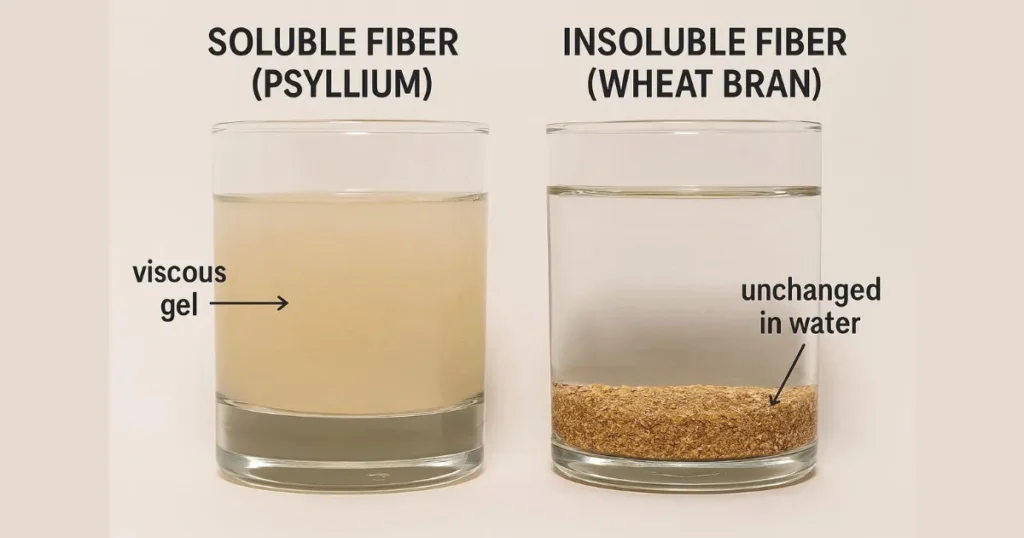
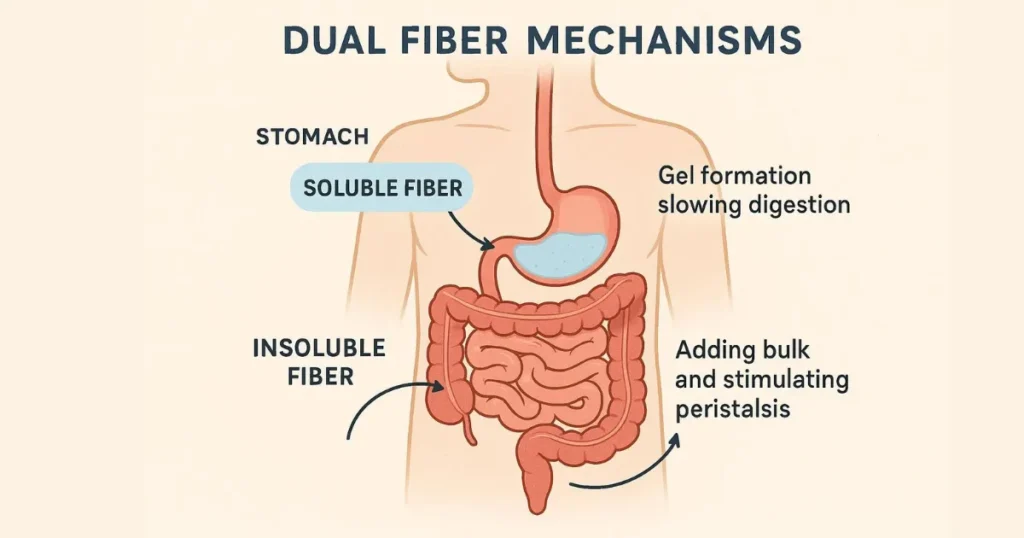
Soluble fiber dissolves in water, forming a gel-like substance in your digestive tract. This gel creates therapeutic effects, including:
- Slowing digestion and glucose absorption
- Trapping cholesterol and bile acids
- Creating prolonged satiety sensation
- Feeding beneficial gut bacteria
- Smoothing bowel movements
What is insoluble fiber:
Insoluble fiber doesn’t dissolve in water. Instead, it:
- Adds bulk to stool
- Speeds transit through the intestines
- Prevents constipation through mechanical action
- Doesn’t form gel
- Passes through largely unchanged
Key functional differences:
| Characteristic | Soluble Fiber | Insoluble Fiber |
| Water solubility | Dissolves completely | Doesn’t dissolve |
| Gel formation | Yes, viscous gel | No gel |
| Fermentation | Partially fermented by bacteria | Minimally fermented |
| Cholesterol effect | Significantly reduces | No effect |
| Blood sugar | Slows absorption dramatically | Minimal effect |
| Satiety | High, prolonged | Moderate, shorter |
| Primary action | Metabolic + mechanical | Mechanical only |
Why both types matter:
Your body needs both fiber types for optimal health. Soluble provides metabolic benefits (cholesterol, blood sugar, weight), while insoluble ensures regular elimination and colon health.
Understanding these differences is crucial for answering: is psyllium husk fiber soluble or insoluble, and what does that mean for your health?
The Definitive Answer: Psyllium’s Fiber Composition
Let me provide the complete answer to whether psyllium husk soluble or insoluble fiber dominates.
The precise composition:
Psyllium husk contains:
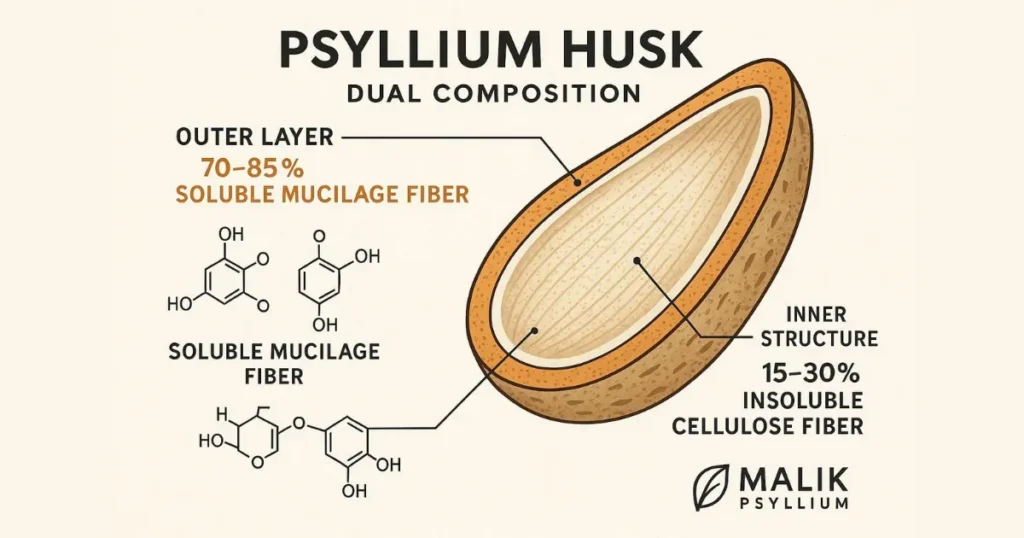
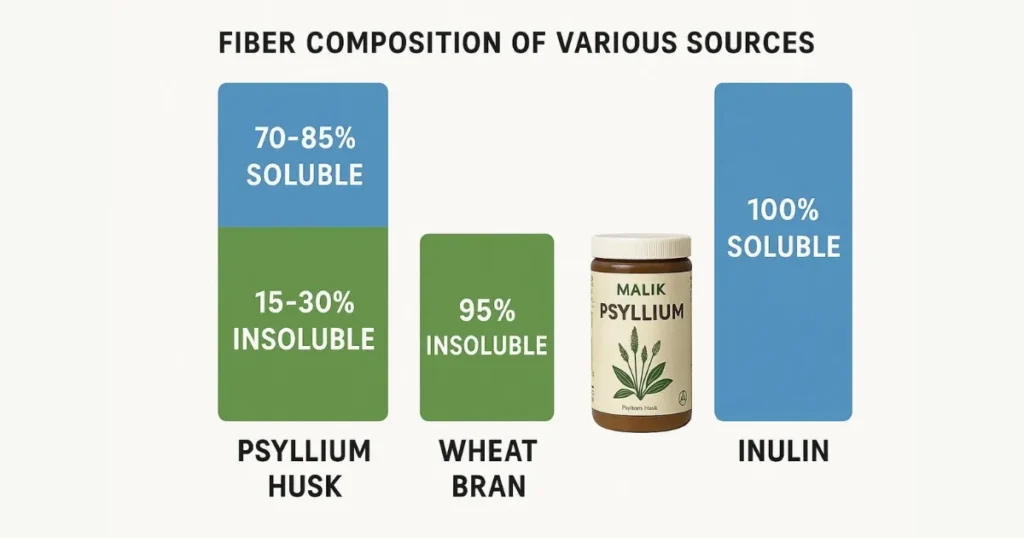
- 70-85% soluble fiber (primarily mucilage).
- 15-30% insoluble fiber (cellulose and hemicellulose).
- Trace amounts of protein and minerals.
Why soluble fiber dominates:
The overwhelming majority of psyllium is soluble fiber, specifically a type called mucilage – complex polysaccharides that form an exceptionally viscous gel when hydrated.
The insoluble fiber component:
While psyllium husk insoluble fiber represents the minority, it contributes:
- Structural integrity of the husk.
- Additional bulk for stool formation.
- Mechanical cleansing through the colon.
- Complementary benefits to soluble fiber.
The synergistic advantage:
This combination of predominantly soluble with some insoluble creates unique benefits:
- Metabolic effects from the soluble component.
- Mechanical benefits from the insoluble component.
- Dual action for both constipation and diarrhea.
- Superior therapeutic versatility.
Quality variations affect composition:
Premium Pakistani psyllium from regions where Malik Psyllium operates contains:
- Higher soluble fiber percentage (80-85%).
- Purer mucilage content.
- More consistent gel formation.
- Superior therapeutic outcomes.
Lower quality psyllium may contain:
- More insoluble fiber (residual seed material).
- Less soluble fiber percentage.
- Inconsistent gel formation.
- Reduced therapeutic effectiveness.
How Psyllium’s Dual Fiber Action Works.
Understanding how both fiber types function explains why psyllium husk fiber soluble or insoluble question matters practically.
Soluble fiber mechanisms in psyllium:
When psyllium’s soluble fiber contacts water:
- Rapid hydration: Absorbs water 10-14 times its weight.
- Gel formation: Creates thick, viscous gel within 2-5 minutes.
- Stomach action: Forms a gel that slows gastric emptying, triggers satiety hormones.
- Small intestine: Gel traps cholesterol in bile acids, slows glucose absorption.
- Large intestine: Provides prebiotic food for beneficial bacteria, produces SCFAs.
- Elimination: Maintains moisture in stool for smooth passage.
Insoluble fiber mechanisms in psyllium:
The psyllium husk insoluble fiber component:
- Structural support: Provides a framework for gel formation.
- Bulk addition: Increases stool volume mechanically.
- Transit stimulation: Stimulates intestinal contractions.
- Colon cleansing: Mechanically scrubs intestinal walls.
- Regular elimination: Promotes consistent bowel movements.
The combined therapeutic effect:
This dual action creates unique benefits:
- For constipation: Soluble fiber adds moisture, insoluble fiber adds bulk – both are essential.
- For diarrhea: Soluble fiber absorbs excess water, and insoluble fiber adds form.
- For IBS: Normalizes function regardless of symptom direction.
- For cholesterol: Soluble fiber binds bile acids effectively.
- For blood sugar: Soluble fiber creates glucose-trapping gel.
- For weight loss: Both create satiety through different mechanisms.
This is why asking if psyllium husk fiber is soluble or insoluble misses the point – it’s the combination that creates superior therapeutic effects.
Clinical Benefits of Psyllium’s Fiber Composition.
Research validates why the psyllium husk soluble or insoluble fiber combination delivers exceptional health benefits.
Cholesterol reduction (soluble fiber effect):
Clinical studies show the soluble fiber in psyllium:
- Reduces LDL cholesterol by 7-15%.
- Lowers total cholesterol by 5-10%.
- Decreases triglycerides modestly.
- Works through the bile acid binding mechanism.
The insoluble component doesn’t affect cholesterol, confirming that soluble fiber drives this benefit.
Blood sugar control (primarily soluble fiber):
Psyllium’s predominantly soluble composition:
- Reduces post-meal glucose spikes by 10-20%.
- Improves HbA1c by 0.5-1.0%.
- Enhances insulin sensitivity.
- Slows carbohydrate digestion and absorption.
Research in Diabetes Care attributes these effects specifically to soluble fiber’s gel-forming properties.
Digestive regularity (both fiber types):
For constipation:
- Soluble fiber: Adds water-retaining gel for moisture.
- Insoluble fiber: Adds bulk, stimulating peristalsis.
- Combined: Produces soft, formed, easily passed stools.
For diarrhea:
- Soluble fiber: Absorbs excess water, firms stools.
- Insoluble fiber: Adds structure and form.
- Combined: Normalizes consistency from both directions.
Weight management (primarily soluble):
The soluble fiber component:
- Creates prolonged satiety (2-4 hours).
- Slows gastric emptying significantly.
- Triggers satiety hormones (CCK, GLP-1, PYY).
- Reduces calorie intake by 300-500 daily.
While psyllium husk insoluble fiber, contributes to fullness, the soluble component drives appetite suppression.
Gut microbiome support (soluble fiber):
The soluble fiber acts as a prebiotic:
- Feeds beneficial bacteria (Lactobacillus, Bifidobacterium).
- Increases populations by 35-40%.
- Produces short-chain fatty acids (SCFAs).
- Reduces harmful bacteria.
Insoluble fiber provides minimal prebiotic effect, confirming soluble fiber drives microbiome benefits.
Cardiovascular protection (soluble fiber):
Beyond cholesterol, soluble fiber:
- Reduces blood pressure modestly (2-4 mmHg).
- Decreases inflammation markers.
- Improves arterial function.
- Lowers cardiovascular disease risk.
Comparing Psyllium to Other Fiber Sources.
Understanding where psyllium falls on the psyllium husk fiber soluble or insoluble spectrum versus other sources clarifies its advantages.
Predominantly soluble fiber sources:
| Source | Soluble % | Key Characteristics |
| Psyllium husk | 70-85% | Best gel formation, highest therapeutic |
| Inulin | 100% | Can cause gas, less bulk |
| Pectin | 100% | Requires large amounts |
| Beta-glucan (oats) | 50-60% | Good but less concentrated |
| Guar gum | 80-90% | Safety concerns if not hydrated |
Predominantly insoluble fiber sources:
| Source | Insoluble % | Key Characteristics |
| Wheat bran | 95% | Harsh, can irritate |
| Cellulose | 100% | No metabolic benefits |
| Lignin | 100% | Minimal health effects |
| Corn bran | 90% | Primarily mechanical |
Balanced fiber sources:
| Source | Soluble/Insoluble | Characteristics |
| Psyllium husk | 70-85% / 15-30% | Optimal therapeutic balance |
| Flaxseed | 40% / 60% | Contains fats/calories |
| Chia seeds | 50% / 50% | High calories, expensive |
Why psyllium’s balance is optimal:
The 70-85% soluble, 15-30% insoluble ratio provides:
- Maximum metabolic benefits from a high soluble percentage.
- Sufficient mechanical action from the insoluble component.
- Superior versatility addressing multiple conditions.
- Better tolerance than 100% soluble or insoluble sources.
This is why, when people ask if psyllium husk fiber is soluble or insoluble, the answer “predominantly soluble with complementary insoluble” makes it uniquely effective.
Practical Usage Based on Fiber Type Understanding.
Knowing whether psyllium husk soluble or insoluble fiber dominates helps optimize usage strategies.
For cholesterol management (targeting soluble fiber):
- Optimal dose: 10-15 grams daily (split morning and evening).
- Timing: With or just before meals containing fats.
- Mechanism: Soluble fiber binds bile acids during digestion.
- Results: 4-8 weeks for measurable LDL reduction.
- Why it works: High soluble fiber percentage drives effect.
For blood sugar control (soluble fiber benefit):
- Optimal dose: 5 grams before each main meal.
- Timing: 30 minutes before eating for maximum effect.
- Mechanism: Gel slows glucose absorption.
- Results: Immediate post-meal improvements, 2-4 weeks for HbA1c.
- Why it works: Soluble fiber creates glucose-trapping gel.
For constipation (both fiber types):
- Optimal dose: 5-10 grams once or twice daily.
- Timing: Morning or evening, consistency matters more.
- Mechanism: Soluble adds moisture, insoluble adds bulk.
- Results: 12-72 hours for first movement, 1-2 weeks for regularity.
- Why it works: Both fiber types contribute synergistically.
For diarrhea (both fiber types):
- Optimal dose: 5 grams 2-3 times daily.
- Timing: Throughout day for consistent effect.
- Mechanism: Soluble absorbs water, insoluble adds form.
- Results: 24-48 hours for firming effect.
- Why it works: Dual action normalizes from opposite directions.
For weight loss (primarily soluble):
- Optimal dose: 5 grams before the two largest meals.
- Timing: 20-30 minutes before eating.
- Mechanism: Soluble fiber creates satiety, reduces intake.
- Results: 2-3 weeks for noticeable appetite reduction.
- Why it works: Soluble fiber’s gel triggers fullness hormones.
Critical hydration requirement (for both types):
Regardless of whether targeting psyllium husk fiber soluble or insoluble benefits:
- Minimum 500ml water per 5-gram dose.
- Total 2-3 liters daily.
- Insufficient water negates benefits, causes problems.
- Both fiber types require hydration to function.
Common Misconceptions about Fiber Types.
Let me address myths about psyllium husk soluble or insoluble fiber I’ve encountered over three decades.
Myth 1: “Psyllium is purely soluble fiber”.
Reality: While predominantly soluble (70-85%), psyllium contains 15-30% insoluble fiber. This combination creates its versatility. Pure soluble fibers like inulin can cause excessive gas – psyllium’s insoluble component provides balance.
Myth 2: “Insoluble fiber is better for constipation”.
Reality: Both types help constipation differently. Psyllium’s high soluble content adds crucial moisture that insoluble-only sources (wheat bran) lack. The combination works better than either alone.
Myth 3: “You can tell fiber type by appearance”.
Reality: You cannot determine if psyllium husk fiber is soluble or insoluble by looking. Both types appear similar and dry. Only laboratory analysis or water testing (gel formation indicates soluble) reveals composition.
Myth 4: “Soluble fiber causes more bloating”.
Reality: While fermentable soluble fibers (inulin, FOS) cause gas, psyllium’s specific mucilage structure causes less fermentation and bloating. The psyllium husk insoluble fiber component also helps by moving material through efficiently.
Myth 5: “All soluble fibers work the same”.
Reality: Soluble fibers vary dramatically. Psyllium’s mucilage forms a uniquely viscous gel (swelling index 12-14) compared to other soluble fibers (6-10). This superior gel formation creates better therapeutic effects.
Myth 6: “More soluble fiber is always better”.
Reality: The 70-85% soluble, 15-30% insoluble ratio in psyllium represents an optimal balance. Pure soluble (100%) can cause excessive gas and slow transit too much. Pure insoluble (100%) provides no metabolic benefits.
Quality Differences in Fiber Composition.
Not all psyllium husk soluble or insoluble fiber ratios are equal – quality dramatically affects composition.
Premium Pakistani psyllium composition:
- Soluble fiber: 80-85% (higher end of range).
- Insoluble fiber: 15-20% (lower end of range).
- Purity: 95-99% pure fiber.
- Swelling index: 12-14 (superior gel formation).
- Mucilage quality: Highest viscosity.
Standard commercial grade composition:
- Soluble fiber: 70-75%.
- Insoluble fiber: 25-30%.
- Purity: 85-92%.
- Swelling index: 8-10.
- Mucilage quality: Moderate viscosity.
Lower grade composition:
- Soluble fiber: 60-70%.
- Insoluble fiber: 30-40% (more residual seed material).
- Purity: 75-85%.
- Swelling index: 6-8.
- Mucilage quality: Poor viscosity.
Why Pakistani psyllium from regions like those where Malik Psyllium operates excels:
- Optimal growing conditions maximize soluble fiber production.
- Superior processing removes more insoluble seed particles.
- Higher purity concentrates beneficial soluble fiber.
- Better swelling creates more therapeutic gel.
- Consistent quality batch to batch.
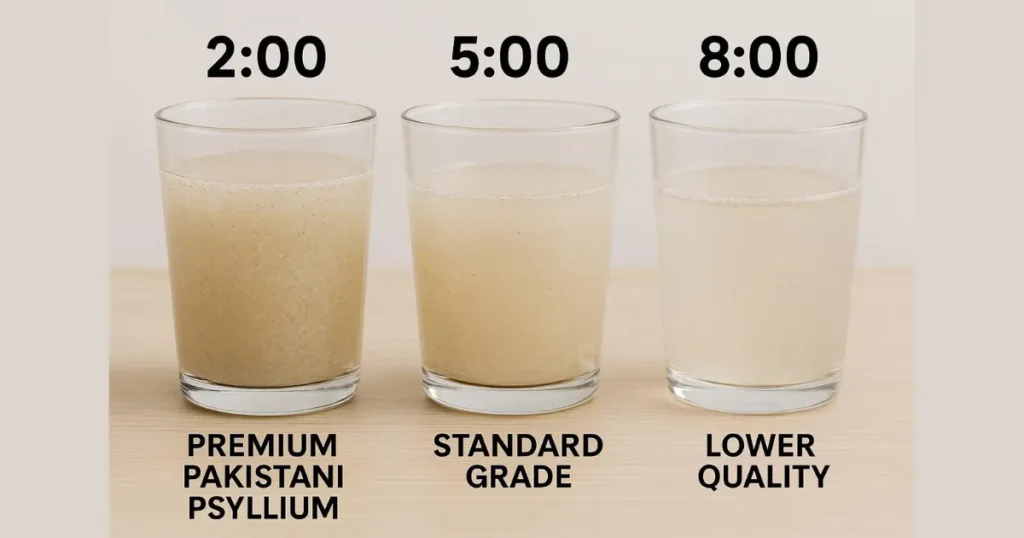
Testing fiber composition at home:
You can estimate the psyllium husk fiber soluble or insoluble ratio:
- Mix 1 teaspoon in 100ml water.
- Stir and observe:
- High soluble: Forms thick gel within 2-3 minutes.
- Lower soluble: Takes 5-8 minutes, forms thin gel.
- High insoluble: Remains grainy, poor gel.
This simple test reveals fiber composition quality.
Scientific Research on Fiber Type Benefits.
Research clarifies which benefits come from psyllium husk soluble or insoluble fiber components.
Cholesterol studies (soluble fiber specific):
Meta-analysis in the American Journal of Clinical Nutrition examined psyllium’s soluble fiber specifically:
- 21 trials, 1,717 participants.
- Soluble fiber component reduced LDL by 0.278 mmol/L.
- No cholesterol effect from the insoluble component.
- Concluded soluble fiber drives cardiovascular benefits.
Blood sugar research (soluble fiber mechanism):
Studies in Diabetes Care tested psyllium’s fiber types:
- Soluble fiber gel slowed glucose absorption.
- Insoluble component had minimal glucose effect.
- Viscosity (soluble fiber property) predicted benefits.
- A higher soluble percentage showed better outcomes.
Satiety studies (primarily soluble):
Research in Appetite compared fiber types:
- Soluble fiber (including psyllium) increased satiety hormones.
- Insoluble fiber showed minimal hormone effect.
- Gel-forming ability (soluble) correlated with fullness.
- Psyllium’s high soluble content explains satiety effects.
Microbiome research (soluble fiber prebiotic effect):
Studies in Alimentary Pharmacology & Therapeutics:
- Soluble fiber increased beneficial bacteria by 35-40%.
- Psyllium husk insoluble fiber, showed minimal bacterial fermentation.
- Short-chain fatty acid production from the soluble component.
- Concluded soluble fiber drives microbiome benefits.
Digestive function (both types important):
Controlled trials on constipation showed:
- Both soluble and insoluble contribute to relief.
- Soluble adds moisture and softness.
- Insoluble adds bulk and stimulates peristalsis.
- Combination (like psyllium’s composition) works best.
Optimizing Benefits Based on Fiber Type.
Strategic usage based on whether targeting psyllium husk soluble or insoluble fiber benefits.
Maximizing soluble fiber benefits:
To emphasize psyllium’s soluble fiber advantages:
- Allow complete gel formation (mix and wait 2-3 minutes).
- Take before meals for metabolic effects (cholesterol, blood sugar).
- Use with warm (not hot) liquids for better gel.
- Choose the highest purity psyllium (more soluble fiber concentrated).
- Maintain consistency for cumulative metabolic benefits.
Leveraging insoluble fiber benefits:
To utilize the psyllium husk insoluble fiber component:
- Consume quickly after mixing (less gel formation, more bulk).
- Take between meals for mechanical cleansing.
- Combine with adequate fluid for optimal bulk effect.
- Use for adding stool volume and stimulating transit.
- Pair with soluble benefits for comprehensive action.
Balanced approach (most common recommendation):
For most health goals, leverage both fiber types:
- Standard mixing (drink within 1-2 minutes of stirring).
- Consistent daily timing for routine benefits.
- Adequate hydration supports both fiber types.
- Allow natural synergy between soluble and insoluble.
- Monitor results and adjust timing/preparation as needed.
Special considerations:
- Very slow transit: Emphasize insoluble benefits (quick consumption, high water).
- Metabolic goals: Emphasize soluble benefits (allow gelling, before meals).
- IBS: Start emphasizing soluble (allow gelling) for gentler action.
- Maintenance: Balanced approach utilizing both fiber types.
Long-Term Use and Fiber Type Considerations.
Understanding psyllium husk fiber soluble or insoluble composition helps long-term strategy.
Why the fiber combination supports long-term use:
- Soluble fiber provides metabolic benefits without tolerance.
- Insoluble fiber ensures mechanical function without dependency.
- Both types remain effective indefinitely.
- No adaptation that reduces benefits.
- Sustainable for lifelong wellness.
Adjusting emphasis over time:
Phase 1 (Weeks 1-4): Establishment.
- Focus on both fiber types equally.
- Build tolerance gradually.
- Establish routine and hydration habits.
- Monitor initial response.
Phase 2 (Months 2-3): Optimization.
- Adjust preparation based on primary goals.
- Emphasize soluble if targeting cholesterol/blood sugar.
- Emphasize insoluble if targeting regularity primarily.
- Fine-tune dosage and timing.
Phase 3 (Months 4+): Maintenance.
- Maintain a balanced approach for comprehensive benefits.
- Both fiber types continue providing value.
- No reduction in effectiveness over time.
- Sustainable indefinite use.
Periodic assessment:
Every 3-6 months, evaluate:
- Whether the current soluble/insoluble balance meets goals.
- If preparation method optimization is needed.
- Whether dosage adjustments are beneficial.
- Overall satisfaction with results.
Is Psyllium Husk Fiber Soluble or Insoluble?
Psyllium husk fiber soluble or insoluble? It’s predominantly soluble (70-85%) with complementary insoluble fiber (15-30%). The soluble mucilage forms a therapeutic gel providing cholesterol reduction, blood sugar control, and satiety. The insoluble component adds bulk and mechanical benefits. This combination creates superior versatility versus single fiber-type sources.
What Is Psyllium Husk Soluble or Insoluble Fiber Percentage?
Psyllium husk soluble or insoluble fiber percentages: Premium Pakistani psyllium contains 80-85% soluble fiber and 15-20% insoluble fiber. Standard grades contain 70-75% soluble, 25-30% insoluble. Higher soluble percentage (from purer processing) correlates with better therapeutic effects for cholesterol, blood sugar, satiety, and gut health.
Does Psyllium Husk Insoluble Fiber Cause Constipation?
No, psyllium husk insoluble fiber, doesn’t cause constipation when used correctly with adequate water. The 15-30% insoluble component adds beneficial bulk and stimulates peristalsis. Combined with a dominant soluble fiber (adds moisture), it relieves constipation effectively. Problems only occur with insufficient hydration (minimum 500ml water per 5g dose).
Which fiber type lowers cholesterol in psyllium?
The soluble fiber component (70-85%) lowers cholesterol, not the insoluble portion. Soluble fiber forms a gel that binds bile acids containing cholesterol, forcing your liver to use blood cholesterol for new bile acid production. This mechanism reduces LDL by 7-15%. Insoluble fiber provides no cholesterol-lowering effect.
Can I get psyllium’s benefits from only soluble or insoluble fiber?
No, the unique 70-85% soluble, 15-30% insoluble combination creates psyllium’s superior versatility. Pure soluble fibers (inulin) cause excessive gas without mechanical benefits. Pure insoluble fibers (wheat bran) lack metabolic benefits and can irritate. Psyllium’s balance provides optimal therapeutic effects with better tolerance than single-type sources.
How does fiber type affect psyllium’s gel formation?
The soluble fiber component (mucilage) forms the therapeutic gel, swelling 10-14 times in water. The insoluble fiber provides a structural framework but doesn’t gel. Higher soluble percentage (80-85% in premium psyllium) creates a thicker, more viscous gel with superior therapeutic effects. Gel viscosity directly correlates with health benefits.
Does psyllium work better for diarrhea or constipation based on fiber type?
Psyllium’s dual fiber composition works for both conditions equally well through complementary mechanisms. For constipation: soluble fiber adds moisture, and insoluble adds bulk. For diarrhea: soluble absorbs excess water, insoluble adds form. This normalizing action from both fiber types makes psyllium uniquely versatile versus single-type fiber sources.
Why is Pakistani psyllium’s fiber composition superior?
Pakistani psyllium demonstrates 80-85% soluble fiber versus 70-75% in standard grades due to optimal growing conditions, superior processing removing more insoluble seed material, and pharmaceutical-grade purity (95-99%). Higher soluble percentage creates better gel formation, stronger therapeutic effects, improved tolerance, and more consistent outcomes batch-to-batch than lower-quality alternatives.
Conclusion.
Understanding that psyllium husk fiber soluble or insoluble isn’t an either-or question but rather a powerful 70-85% soluble, 15-30% insoluble combination clarifies why psyllium delivers superior therapeutic versatility compared to fiber sources containing only one type. The predominantly soluble composition – specifically the mucilage that forms an exceptionally viscous gel – drives psyllium’s clinically proven benefits for cholesterol reduction, blood sugar stabilization, appetite control, and gut microbiome enhancement, while the complementary psyllium husk insoluble fiber component provides essential mechanical benefits for stool bulk, transit stimulation, and colon cleansing that pure soluble fibers lack.
After three decades cultivating premium psyllium and witnessing countless success stories globally, I can confirm that quality matters tremendously for fiber composition – Pakistani psyllium from optimal growing regions consistently demonstrates 80-85% soluble fiber content with superior gel-forming properties versus 70-75% in standard grades, translating to better therapeutic outcomes with smaller doses and fewer side effects.
Whether addressing digestive irregularity, managing cholesterol or diabetes, supporting weight loss, or optimizing overall wellness, understanding the psyllium husk soluble or insoluble fiber balance helps you strategically leverage both components through proper preparation, timing, and consistency for maximum health benefits backed by rigorous scientific research and validated by millions of satisfied users worldwide who have discovered why this unique fiber combination from quality sources like Malik Psyllium represents nature’s most effective and versatile digestive and metabolic wellness solution.

Isabgol Ke Fayde – Psyllium Husk Ke Poori Science-Based Rahnumayi – 2026
Isabgol ke fayde jaanna aaj ke daur mein zyada zaroori
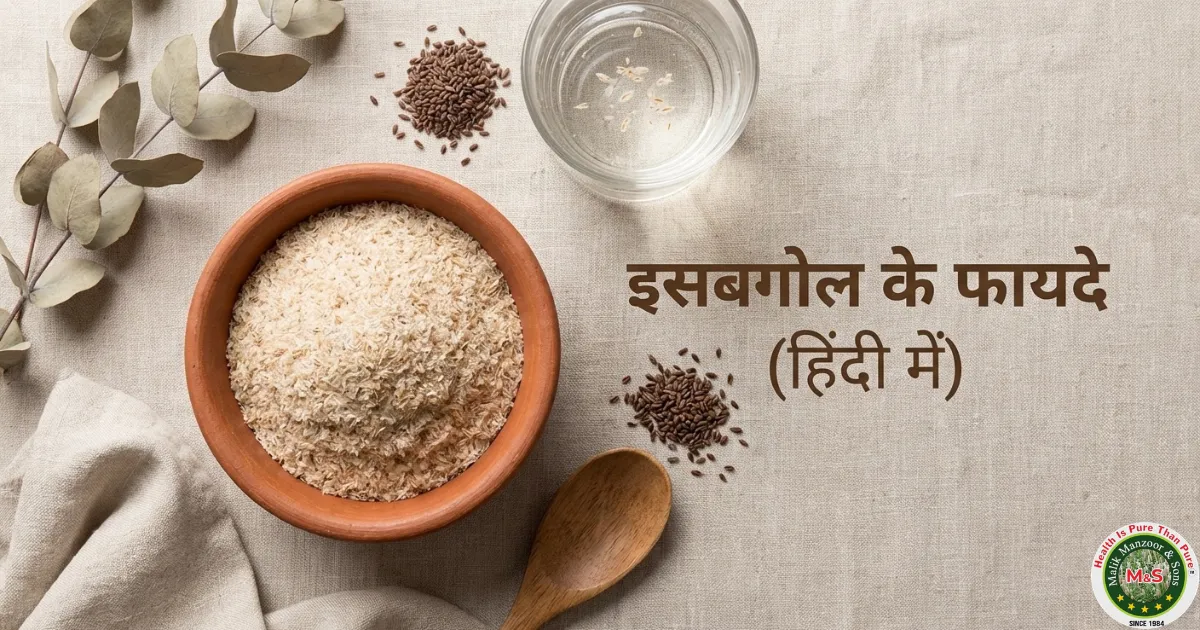
Isabgol Benefits in Hindi | Psyllium Husk Ke Fayde, Sahi Upyog Aur Savdhaniyan – 2026
Agar aap isabgol benefits in hindi mein samajhna chahte hain,