
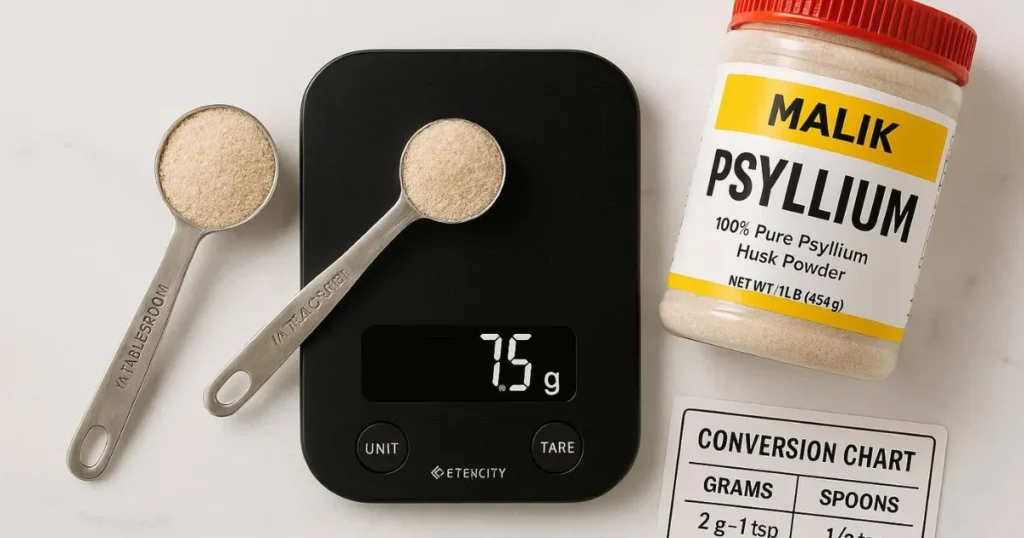
Confusion about measurements causes more psyllium dosing errors than anything else. Understanding exactly how much 1 tablespoon psyllium husk in grams represents – and knowing how many teaspoons is 5 grams of psyllium husk – ensures you get proper benefits without side effects. The challenge stems from psyllium’s light, fluffy texture that creates inconsistent volume measurements depending on how you scoop it.
In this comprehensive guide, I’ll provide precise gram conversions for every common measurement, explain why weight matters more than volume, show you exactly how many teaspoons is 5 grams of psyllium husk with visual references, and teach reliable measuring techniques that work whether you use spoons or scales. You’ll discover conversion charts for tablespoons to grams, teaspoons to grams, and everything in between, plus troubleshooting tips when measurements seem off.
Why Accurate Psyllium Measurements Matter
Before diving into conversions, let’s understand why precision with 1 tablespoon psyllium husk in grams is so critical.
Health Benefits Require Proper Dosing
Research shows specific health benefits occur at precise psyllium doses:
- Cholesterol reduction: Requires 7+ grams daily
- Blood sugar control: Effective at 5-10 grams per meal
- Constipation relief: Needs 5-10 grams daily minimum
- Weight management: Best results at 5 grams before meals
Taking 2-3 grams when you think you’re taking 5 grams means missing therapeutic thresholds entirely.
Too Much Causes Problems
Excessive psyllium intake creates uncomfortable side effects:
- Severe bloating and gas
- Abdominal cramping
- Diarrhea or loose stools
- Potential intestinal blockage (with inadequate water).
Measuring 8 grams instead of 5 grams might seem minor, but that 60% increase significantly impacts your digestive system.
Volume Measurements Are Unreliable.
Psyllium’s fluffy texture makes volume measurements highly variable. The same tablespoon can contain 5-10 grams depending on:
- How compacted the powder is.
- Whether you level off the spoon.
- Humidity levels affecting powder density.
- Brand and quality differences.
This is why knowing exactly how much 1 tablespoon psyllium husk in grams weighs for YOUR specific product matters tremendously.
The Definitive Answer: 1 Tablespoon Psyllium Husk in Grams.
Let me provide the precise measurements you need.
Standard Conversion.
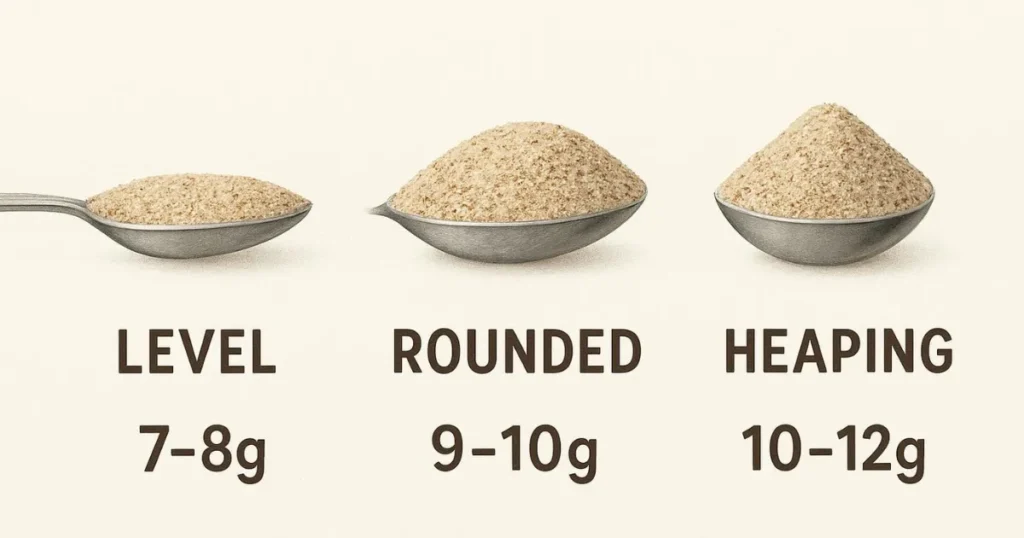
1 level tablespoon of psyllium husk powder = 7-8 grams.
This is the most common range across quality brands. However, variations exist based on:
- Grinding fineness (finer powder weighs more per tablespoon).
- Moisture content (humid conditions increase weight).
- Purity level (higher purity = more consistent weight).
- Whether husks are whole or powdered.
Pakistani psyllium husk, particularly premium grades like those from Malik Psyllium, tends toward the higher end (7.5-8 grams per tablespoon) due to superior purity and fine grinding.
Complete Tablespoon Conversion Chart.
| Measurement | Weight Range | Average Weight |
| 1 level tablespoon | 7-8 grams | 7.5 grams |
| 1 heaping tablespoon | 10-12 grams | 11 grams |
| 1 rounded tablespoon | 9-10 grams | 9.5 grams |
| ½ tablespoon | 3.5-4 grams | 3.75 grams |
| 1½ tablespoons | 10.5-12 grams | 11.25 grams |
| 2 tablespoons | 14-16 grams | 15 grams |
Important note: Always use level tablespoons unless recipes specifically state otherwise. Most health recommendations assume level measurements.
How Many Teaspoons Is 5 Grams of Psyllium Husk?
This is the second most common measurement question I encounter.
The Precise Answer.
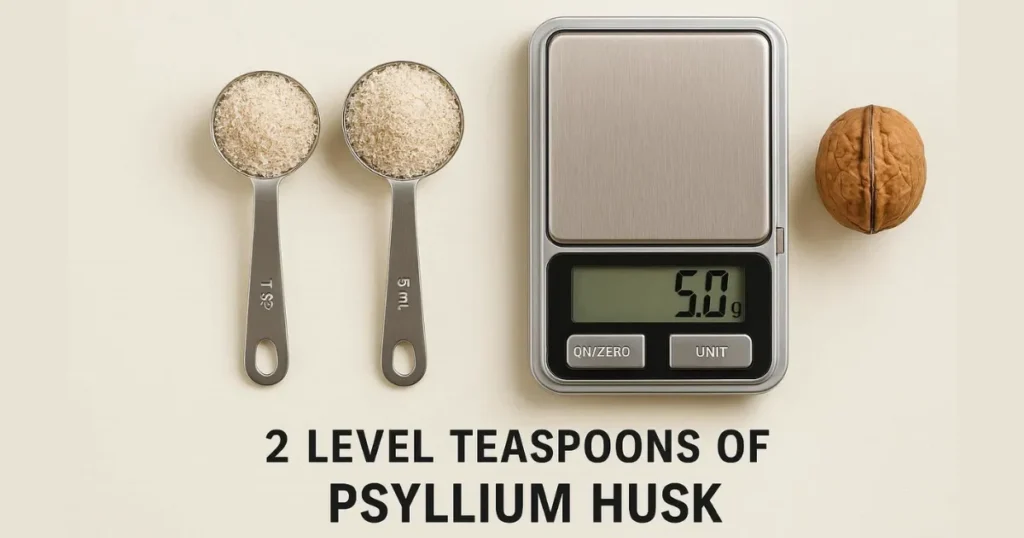
5 grams of psyllium husk = approximately 2 level teaspoons.
More specifically:
- 1 level teaspoon = 2.5 grams (average).
- 2 level teaspoons = 5 grams (standard daily dose).
- 3 level teaspoons = 7.5 grams (1 tablespoon equivalent).
Why This Conversion Matters.
Five grams represents the standard single serving size recommended for:
- Daily digestive health maintenance.
- Pre-meal appetite suppression.
- Blood sugar management before meals.
- Starting dose for new users.
Knowing how many teaspoons is 5 grams of psyllium husk lets you measure accurately when tablespoons aren’t convenient or when you need to split doses precisely.
Teaspoon Conversion Chart.
| Teaspoons | Grams (Average) | Common Use |
| ½ teaspoon | 1.25 grams | Starting dose for children |
| 1 teaspoon | 2.5 grams | Beginner adult dose |
| 2 teaspoons | 5 grams | Standard single dose |
| 3 teaspoons | 7.5 grams | Higher therapeutic dose |
| 4 teaspoons | 10 grams | Maximum single dose |
Complete Psyllium Measurement Conversion Reference.
Grams to Common Measures.
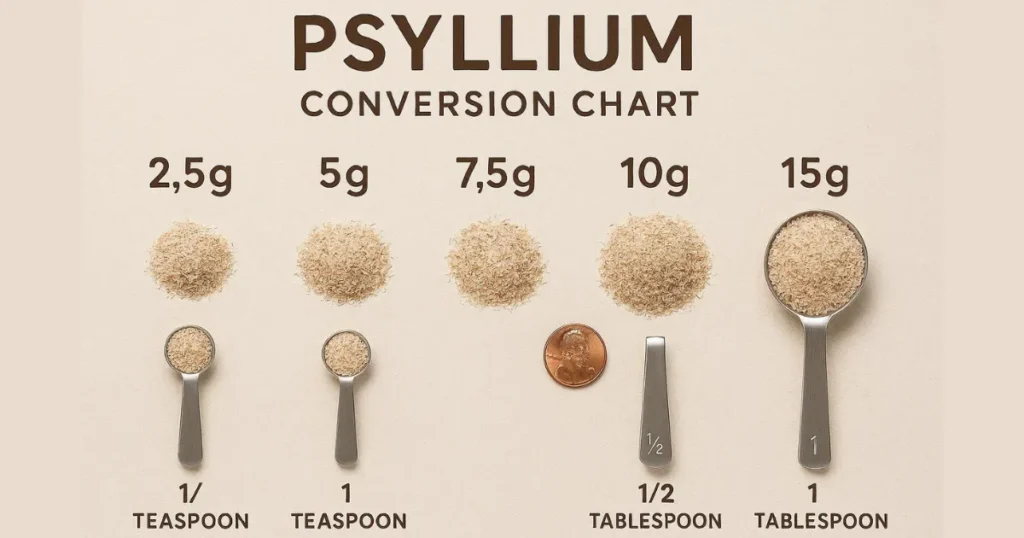
This reverse conversion helps when recipes or recommendations specify gram amounts.
| Grams | Teaspoons | Tablespoons | Visual Reference |
| 2.5g | 1 level | ⅓ level | Size of a marble |
| 5g | 2 level | ⅔ level | Size of a walnut |
| 7.5g | 3 level | 1 level | Size of a golf ball |
| 10g | 4 level | 1⅓ level | Size of a lime |
| 15g | 6 level | 2 level | Size of an egg |
| 20g | 8 level | 2⅔ level | Size of a small lemon |
Measuring Cups to Grams.
Less commonly used but helpful for bulk preparation:
- 1/4 cup = 30-35 grams (about 4-5 tablespoons).
- 1/3 cup = 40-45 grams (about 5-6 tablespoons).
- 1/2 cup = 60-70 grams (about 8-9 tablespoons).
- 1 cup = 120-140 grams (about 16-18 tablespoons).
These larger measurements work well when preparing recipes requiring substantial psyllium, like keto bread or bulk smoothie mixes.
Why Volume and Weight Differ: The Science.
Understanding why 1 tablespoon psyllium husk in grams varies helps you measure more accurately.
Particle Size Variations.
Finer psyllium powder packs more densely than coarser ground husks. Pakistani psyllium is typically ground finer than alternatives, resulting in:
- More consistent weight per volume.
- Higher grams per tablespoon (7.5-8g vs. 6-7g).
- Better measuring reliability.
Humidity Effects.
Psyllium is hygroscopic – it absorbs moisture from air. In humid conditions:
- Powder clumps slightly.
- Weight per tablespoon increases.
- Volume measurements become less accurate.
This is why knowing how many teaspoons is 5 grams of psyllium husk matters more than “approximately 2 teaspoons” – you need to verify with your specific product.
Settling and Compaction.
During shipping and storage, psyllium settles. The top of a fresh container measures differently than the bottom:
- Top: Fluffier, lighter, fewer grams per tablespoon.
- Bottom: More compact, heavier, more grams per tablespoon.
- Solution: Stir or shake your psyllium container before measuring to ensure consistency.
Purity Differences.
Higher purity psyllium contains more actual fiber and less filler or hull fragments:
- 95%+ purity (premium Pakistani): More consistent, predictable measurements.
- 70-80% purity (standard grade): More variable, less reliable volume-to-weight ratios.
How to Measure Psyllium Accurately Without a Scale.
Not everyone owns a kitchen scale. Here’s how to measure 1 tablespoon psyllium husk in grams accurately using only spoons.
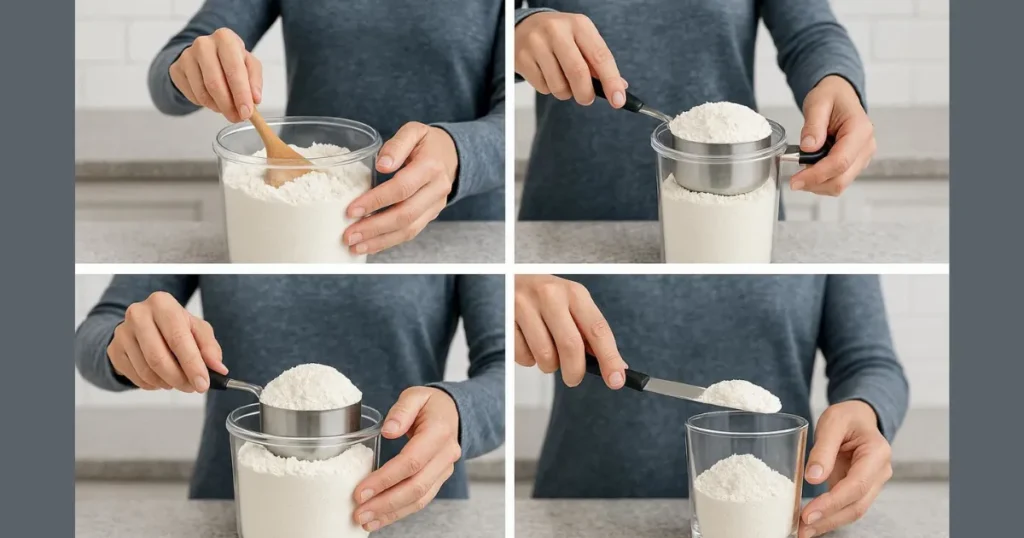
The Scoop and Level Method.
- Step 1: Stir psyllium in container to fluff and distribute evenly.
- Step 2: Dip measuring spoon into powder without packing down.
- Step 3: Lift spoon straight up – don’t tap or shake.
- Step 4: Level off with straight edge (knife back or spatula).
- Step 5: Transfer to glass for mixing.
This method produces most consistent volume-based measurements, though still less precise than weighing.
Visual Verification Technique.
Even without a scale, you can verify measurements visually:
For 5 grams (2 teaspoons):
- Should look like small mound in your palm.
- About the size of a walnut shell.
- Roughly fills a tablespoon measure 2/3 full when leveled.
For 7.5 grams (1 tablespoon):
- Fills tablespoon measure completely when leveled.
- Approximately size of a golf ball.
- Creates visible layer across bottom of standard water glass.
The Calibration Test.
Establish your personal conversion:
- Borrow or buy an inexpensive digital scale ($ 10-15).
- Measure “your” 1 tablespoon three times.
- Average the weights.
- Mark the result on your psyllium container.
- Use this personal conversion going forward.
Now you know exactly how much 1 tablespoon psyllium husk in grams weighs for YOUR specific product and measuring technique.
Professional Measuring: Using a Digital Scale.
For absolute precision, especially when taking psyllium therapeutically, invest in a digital kitchen scale.
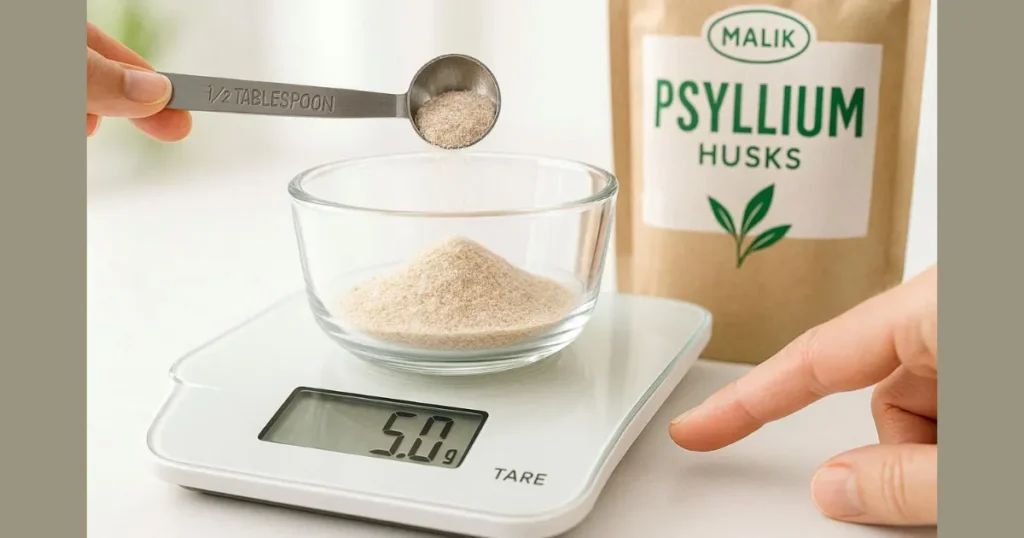
Choosing the Right Scale.
Essential features:
- 0.1 gram precision minimum.
- Tare function (zero out container weight).
- Maximum capacity of at least 500 grams.
- Easy-to-read display.
- Stable, flat surface.
Cost: Quality scales range from $12-25, lasting years with proper care.
Step-by-Step Scale Measurement.
Step 1: Place empty glass on scale, press tare (reads 0.0 g).
Step 2: Add psyllium until scale reads desired amount:
- 2.5 g for beginner dose.
- 5.0 g for standard dose.
- 7.5 g for higher dose.
- 10.0 g for the maximum single dose.
Step 3: Add water and consume.
This method eliminates all guesswork about how many teaspoons is 5 grams of psyllium husk – the scale tells you precisely.
Benefits of Scale Measurement.
- Consistency: Same dose every single time.
- Flexibility: Easy to adjust by 0.5-1 gram increments.
- Verification: Confirms product label accuracy.
- Experimentation: Helps find your optimal personal dose.
Common Measurement Mistakes and Solutions.
Mistake 1: Using Heaping Measurements.
The problem: Recipes and health recommendations assume level measurements. Heaping adds 30-50% more.
Example: Heaping tablespoon = 10-12 grams instead of 7-8 grams.
Solution: Always level off spoons unless specifically instructed otherwise.
Mistake 2: Packing Down the Powder.
The problem: Pressing psyllium into measuring spoon increases weight by 20-40%.
Example: Packed tablespoon = 9-10 grams instead of 7-8 grams.
Solution: Gently scoop and level without tapping or compressing.
Mistake 3: Measuring from Settled Container Bottom.
The problem: Compact bottom powder weighs more per volume than fluffy top powder.
Solution: Stir container thoroughly before every measurement.
Mistake 4: Using Liquid Measuring Cups.
The problem: Liquid measures (with spouts) are less accurate for dry ingredients.
Example: “1 tablespoon” in liquid measure ≠ standard tablespoon.
Solution: Use proper dry measuring spoons for consistency.
Mistake 5: Assuming All Brands Measure the Same.
The problem: Different psyllium qualities have different densities.
Solution: Calibrate measurements for each new brand or product.
Converting Recipes and Dosage Recommendations.
Understanding 1 tablespoon psyllium husk in grams helps adapt recipes and health protocols.
Recipe Conversions.
Original recipe calls for:
- “1 tablespoon psyllium” → Aim for 7-8 grams.
- “2 teaspoons psyllium” → Aim for 5 grams.
- “1/2 tablespoon psyllium” → Aim for 3.5-4 grams.
Health recommendation states:
- “5 grams daily” → Use 2 level teaspoons.
- “10 grams twice daily” → Use 1 1/3 tablespoons per dose.
- “7 grams with meals” → Use 1 level tablespoon (approximately).
International vs. US Measurements.
- US tablespoon: 14.8 ml = 7-8 grams psyllium.
- UK/Australian tablespoon: 17.8 ml = 8.5-9.5 grams psyllium.
- Metric tablespoon (15 ml): 7-8 grams psyllium.
If following international recipes, verify which tablespoon size they reference. Most health research uses US measurements.
Quality Impact on Measurement Accuracy.
Premium psyllium provides more reliable measurements than lower-grade alternatives.
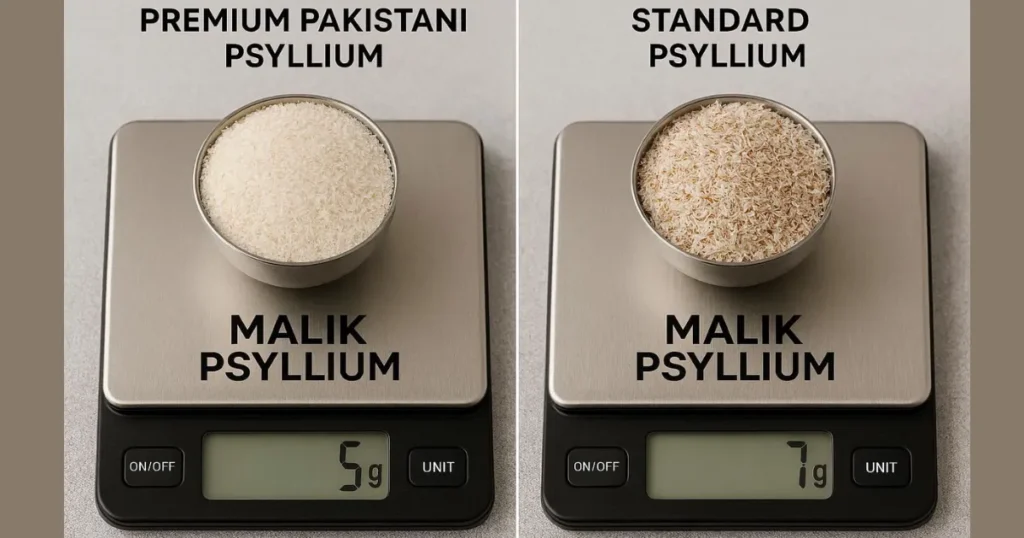
Pakistani vs. Standard Psyllium.
Pakistani psyllium characteristics:
- 85-99% purity (vs. 60-75% standard).
- Finer, more uniform grinding.
- Consistent 7.5-8 grams per level tablespoon.
- More predictable swelling and gel formation.
When you use quality psyllium from sources like Malik Psyllium, your measurements stay consistent batch to batch. Lower-quality psyllium varies significantly, making the question of how much 1 tablespoon psyllium husk in grams represents harder to answer definitively.
Visual Quality Indicators.
Premium psyllium:
- Light beige/cream color.
- Fine, uniform powder.
- No visible hull fragments or debris.
- Consistent texture throughout.
Lower-grade psyllium:
- Darker brown/tan color.
- Coarse or irregular particles.
- Visible hull pieces.
- Variable texture.
Higher quality means more reliable measurements and better results.
Adjusting Measurements for Different Forms.
Psyllium comes in several forms, each with different volume-to-weight ratios.
Psyllium Husk Powder.
Standard measurements:
- 1 tablespoon = 7-8 grams.
- 1 teaspoon = 2.5 grams.
This is the most common form, used in all measurements discussed here.
Whole Psyllium Husks.
Adjusted measurements:
- 1 tablespoon = 4-5 grams (much lighter).
- 1 teaspoon = 1.5-2 grams.
Whole husks are fluffier and less dense. You need MORE volume for same weight. If a recipe calls for 5 grams powder, use about 2 1/2 tablespoons whole husks.
Psyllium Capsules.
Typical capsules:
- Standard capsule = 500-750 mg (0.5-0.75 grams).
- 7-10 capsules = approximately 1 tablespoon powder.
- 6-7 capsules = approximately 5 grams.
Capsules offer pre-measured convenience but cost more per gram.
How Many Teaspoons Is 5 Grams of Psyllium Husk: Practical Applications.
Let’s apply this knowledge to real-world scenarios.
Daily Maintenance Dose.
- Recommendation: 5 grams once daily.
- Measurement: 2 level teaspoons.
- Timing: Morning before breakfast.
- Water: 10-12 ounces minimum.
Pre-Meal Appetite Control.
- Recommendation: 5 grams before lunch and dinner.
- Measurement: 2 level teaspoons per dose (4 teaspoons daily total).
- Timing: 20-30 minutes before eating.
- Water: 10 ounces per dose.
Cholesterol Management Protocol.
- Recommendation: 7-10 grams daily, split doses.
- Measurement Option 1: 1 level tablespoon once daily.
- Measurement Option 2: 2 level teaspoons (5g) morning + 1 1/2 teaspoons (3.75 g) evening.
- Water: 10-12 ounces per dose.
Constipation Relief.
- Recommendation: 5-10 grams daily.
- Measurement: 2-4 level teaspoons (or 1-1 1/2 tablespoons).
- Timing: Evening, 2 hours after dinner.
- Water: 12-16 ounces.
Keto Baking.
- Recipe requirement: 3 tablespoons (approximately 22-24 grams).
- Measurement: Ideally, weigh for precision.
- Alternative: 3 level tablespoons (21-24 grams typical range).
- Purpose: Provides structure and binding in low-carb bread.
Travel and Convenience Measuring.
Maintaining accurate dosing away from home requires planning.
Pre-Measuring for Travel.
Method 1: Individual portions.
- Measure 5-gram portions into small ziplock bags.
- Label each bag clearly.
- Pack the exact number needed for the trip.
Method 2: Pre-measured container.
- Use a small container with a measuring spoon attached.
- Mark the container with tablespoon/teaspoon lines.
- Brings just enough for the trip duration.
Restaurant or Office Measuring.
Without measuring tools:
- Request sugar packet (1 packet ≈ 1 teaspoon ≈ 2.5 grams).
- Two sugar packets of psyllium ≈ 5 grams.
- Not precise but workable in a pinch.
With coffee shop access:
- Ask for a measuring spoon.
- Most have teaspoons for coffee service.
- Quick, discreet measurement.
Capsule Conversion for Travel.
- Pre-calculate: Your 5-gram dose = approximately 7 capsules (500mg each).
- Advantage: No measuring needed, TSA-friendly, discreet.
- Disadvantage: More expensive, can’t be used in recipes.
Verifying Commercial Product Claims.
Understanding measurements helps evaluate product labeling accuracy.
Label Reading.
Check serving size specifications:
- “Serving size: 1 tablespoon (7g)” = standard, accurate.
- “Serving size: 1 tablespoon (5g)” = possibly fluffy/less pure product.
- “Serving size: 1 tablespoon (10g)” = very dense or possibly mislabeled.
If the label seems off, verify with the scale. Some companies use heaping tablespoons or compressed measurements to make servings appear larger.
Cost per Gram Calculation.
- Product A: $15 for 500g = $0.03 per gram.
- Product B: $12 for 300g = $0.04 per gram.
Product A offers better value despite a higher price. Understanding grams makes price comparison accurate.
Dosage Accuracy.
- Label claims: “Provides 5g fiber per serving”.
- Serving is defined as: “1 tablespoon”.
Verification: Weigh a tablespoon. Should be 7-8 grams total, of which 5-6 grams is actual fiber (the rest is non-fiber bulk).
Measuring for Different Health Goals.
Optimal dosing varies by objective. Here’s how to measure for specific benefits.
For Digestive Regularity.
- Target dose: 5-10 grams daily.
- How to measure: 2-4 level teaspoons, or 1-1 1/2 tablespoons.
- Frequency: Once daily, preferably evening.
- Adjustment: Start with 5g (2 tsp), increase to 10g (4 tsp) if needed after one week.
For Blood Sugar Control.
- Target dose: 5 grams per meal.
- How to measure: 2 level teaspoons before each main meal.
- Frequency: Up to 3 times daily (15g total maximum).
- Adjustment: Critical to be precise – variations affect glucose response.
For Weight Management.
- Target dose: 5 grams before meals.
- How to measure: Exactly 2 level teaspoons.
- Frequency: Before the 2 largest meals daily.
- Adjustment: Consistency matters more than amount.
For Cholesterol Reduction.
- Target dose: 7-10 grams daily.
- How to measure: 1 level tablespoon once daily, OR 2 teaspoons twice daily.
- Frequency: With or just before meals.
- Adjustment: Requires 8-12 weeks to see results; maintain exact dosing.
Teaching Others to Measure Correctly.
If family members or caregivers help with your psyllium dosing, clear instructions prevent errors.
Create a Visual Guide.
Take photos of:
- Correct scoop technique.
- Level measurement.
- Proper portions in measuring spoon.
- Amount in glass before mixing.
Post these near your psyllium container for reference.
Use Consistent Tools.
Designate specific measuring spoons:
- Mark with tape or nail polish.
- Keep with psyllium container.
- Don’t use for other purposes.
This prevents confusion about which spoon measures accurately.
Written Instructions.
Simple checklist:
- Stir psyllium in the container.
- Scoop gently without packing.
- Level with the knife back.
- Should equal X grams 5. Mix with 10 oz of water immediately.
How much is 1 tablespoon psyllium husk in grams exactly?
1 level tablespoon of psyllium husk powder = 7-8 grams on average. Premium Pakistani psyllium typically measures 7.5-8 grams per tablespoon due to fine grinding and high purity.
How many teaspoons is 5 grams of psyllium husk?
5 grams of psyllium husk = approximately 2 level teaspoons. More precisely, 1 teaspoon = 2.5 grams, so 2 teaspoons = 5 grams (standard single serving dose).
Why does my tablespoon measure differently from 7-8 grams?
Variations occur from humidity, powder compaction, purity level, and measuring technique. Heaping tablespoons contain 10-12g; packed tablespoons contain 9-10g. Always use level measurements and stir psyllium before scooping.
Can I use liquid measuring spoons for psyllium?
No, liquid measures are less accurate for dry ingredients. Use standard dry measuring spoons and level off with a straight edge for consistency. Liquid measures can vary by 15-20%.
How do I measure psyllium without a scale?
Use the scoop-and-level method: stir container, gently scoop without packing, level with knife back. 2 level teaspoons = approximately 5g; 1 level tablespoon = approximately 7.5 g.
Do whole psyllium husks measure the same as powder?
No, whole husks are much lighter and fluffier. 1 tablespoon whole husks = 4-5 grams (vs. 7-8g powder). Use approximately 50% more volume when substituting whole husks for powder.
How many grams of psyllium should I take daily?
5-10 grams daily for general health; 7-10 grams for cholesterol management; 5 grams before meals for blood sugar control. Start with 2.5-5g and increase gradually over 2 weeks.
Is Pakistani psyllium husk measured differently?
Pakistani psyllium’s higher purity (85-99%) and finer grinding create more consistent measurements. 1 tablespoon typically equals 7.5-8g reliably, while lower-grade psyllium varies more (6-10g per tablespoon).
Conclusion.
Understanding precisely how much 1 tablespoon psyllium husk in grams represents – typically 7-8 grams for quality powder – eliminates the guesswork that leads to under-dosing or side effects from excess. Knowing exactly how many teaspoons is 5 grams of psyllium husk (approximately 2 level teaspoons) ensures you achieve therapeutic doses for cholesterol management, blood sugar control, digestive regularity, and weight management without measuring errors that compromise results.
The challenge with psyllium measurements stems from its light, fluffy texture that creates variable volume-to-weight ratios depending on humidity, particle size, purity, and measuring technique. Premium Pakistani psyllium offers more consistent measurements (7.5-8 grams per tablespoon) compared to lower-grade alternatives that may vary from 6-10 grams per tablespoon depending on compaction.
For maximum accuracy, invest in an inexpensive digital kitchen scale that measures to 0.1-gram precision – this eliminates all ambiguity about 1 tablespoon psyllium husk in grams and lets you adjust doses by precise increments. When scales aren’t available, use the scoop-and-level method with designated measuring spoons, stir your psyllium container before measuring, and verify your technique occasionally against known weights. Whether you’re following recipes, health protocols, or personal wellness routines, precise measurement transforms psyllium from an inconsistent supplement to a reliable therapeutic tool that delivers predictable, beneficial results every single time.

Isabgol Ke Fayde – Psyllium Husk Ke Poori Science-Based Rahnumayi – 2026
Isabgol ke fayde jaanna aaj ke daur mein zyada zaroori
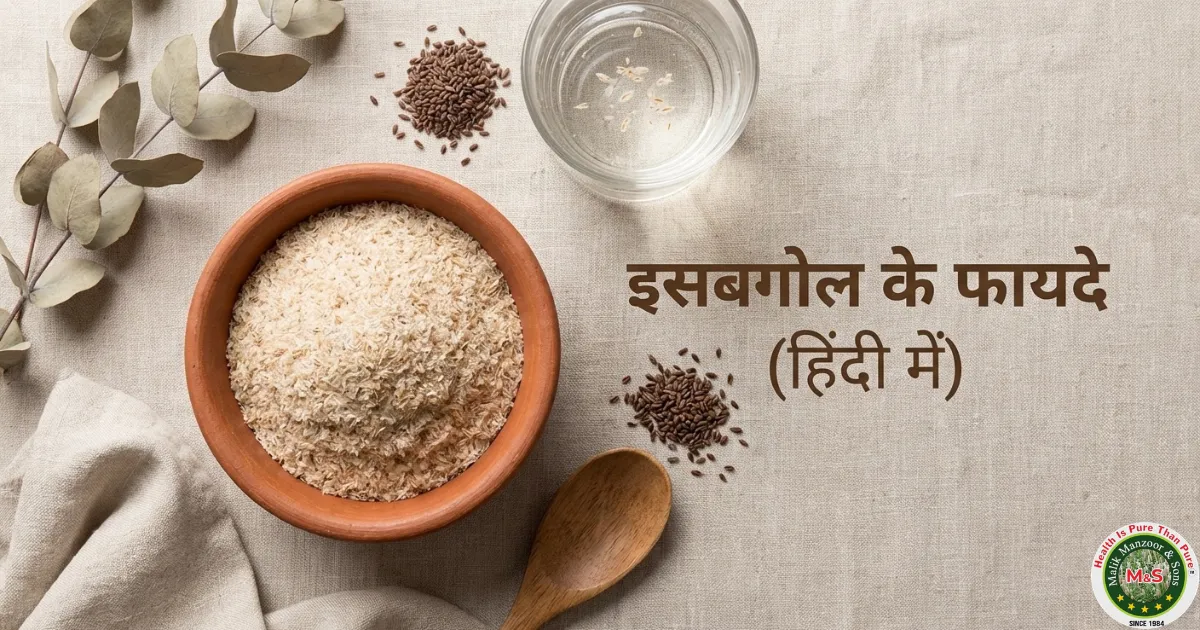
Isabgol Benefits in Hindi | Psyllium Husk Ke Fayde, Sahi Upyog Aur Savdhaniyan – 2026
Agar aap isabgol benefits in hindi mein samajhna chahte hain,